missing translation for 'onlineSavingsMsg'
Learn More
Learn More
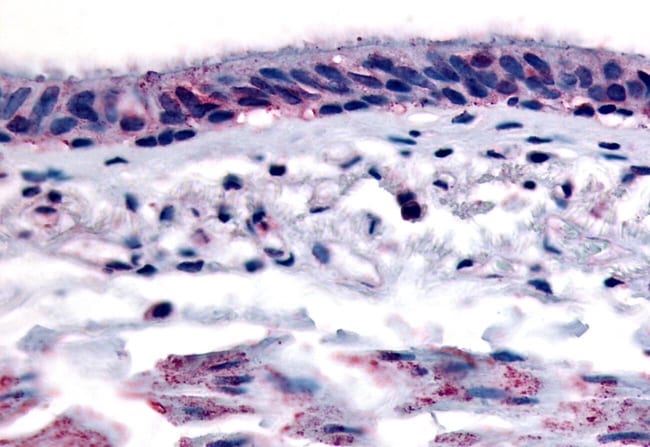
Invitrogen™ AHR Polyclonal Antibody

Rabbit Polyclonal Antibody
Brand: Invitrogen™ PA532662
This item is not returnable.
View return policy
Description
For IHC(P), use heat induced antigen retrieval in pH 6.0 citrate buffer. After incubation with the primary antibody, slides were incubated with biotinylated secondary antibody, followed by alkaline phosphatase-streptavidin and chromogen. Percent identity with other species by BLAST analysis: Human, Gorilla (100%) Gibbon (94%) Monkey, Bat, Elephant, Guinea pig (88%) Marmoset, Bovine, Hamster (81%).
AHR (Ah Receptor) belongs to a family of proteins comprised of its dimerization partner ARNT (HIF-1 Beta) and the Drosophila proteins PER and SIM. AHR contains an N-terminal sequence of approximately 200 amino acids termed the PAS domain. AHR, found in a variety of tissues, binds to a specific DNA enhancer sequence and initiates transcription of the mRNA for the cytochrome P-450 (CYPIA1) gene. The gene for AHR encodes a ligand-activated transcription factor involved in the regulation of biological responses to planar aromatic hydrocarbons. AHR has been shown to regulate xenobiotic-metabolizing enzymes such as cytochrome P450, and its ligands included a variety of aromatic hydrocarbons. AHR is a ligand-activated helix/loop/helix transcription factor found in a variety of vertebrate species. The known ligands for AHR are foreign planar aromatic compounds, such as polycyclic aromatic compounds and halogenated aromatic compounds such as 2,3,7,8-tetrachlorodibenzo-p-dioxin (TCDD). Unlike the steroid/thyroid hormone receptors, there is no known physiological ligand for AHR. Studies indicate that in non-ligand activated cells, AHR is found complexed with HSP90 predominantly in the cytoplasm. Upon binding to an agonist, the ligand-activated AhR is believed to transform to a nuclear, DNA binding form, and this transformation process appears to involve dissociation of HSP90 from AhR followed by formation of a heterodimer with AhR nuclear translocator protein (Arnt). Diseases associated with AHR include eosinophilic fasciitis and seborrheic dermatitis.
Specifications
| AHR | |
| Polyclonal | |
| Unconjugated | |
| AHR | |
| Ah; Ah receptor; Ahh; Ahr; Ahre; AH-receptor; aromatic hydrocarbon receptor; aryl hydrocarbon receptor; aryl-hydrocarbon receptor; bHLHe76; Class E basic helix-loop-helix protein 76; dioxin receptor; In | |
| Rabbit | |
| Antigen affinity chromatography | |
| RUO | |
| 196 | |
| Store at 4°C short term. For long term storage, store at -20°C, avoiding freeze/thaw cycles. | |
| Liquid |
| Immunohistochemistry (Paraffin) | |
| 1 mg/mL | |
| PBS with 0.1% sodium azide | |
| P35869 | |
| AHR | |
| Synthetic 16 amino acid peptide from C-terminus of human Aryl Hydrocarbon Receptor. | |
| 50 μg | |
| Primary | |
| Human | |
| Antibody | |
| IgG |
Product Content Correction
Your input is important to us. Please complete this form to provide feedback related to the content on this product.
Product Title
Spot an opportunity for improvement?Share a Content Correction