Learn More

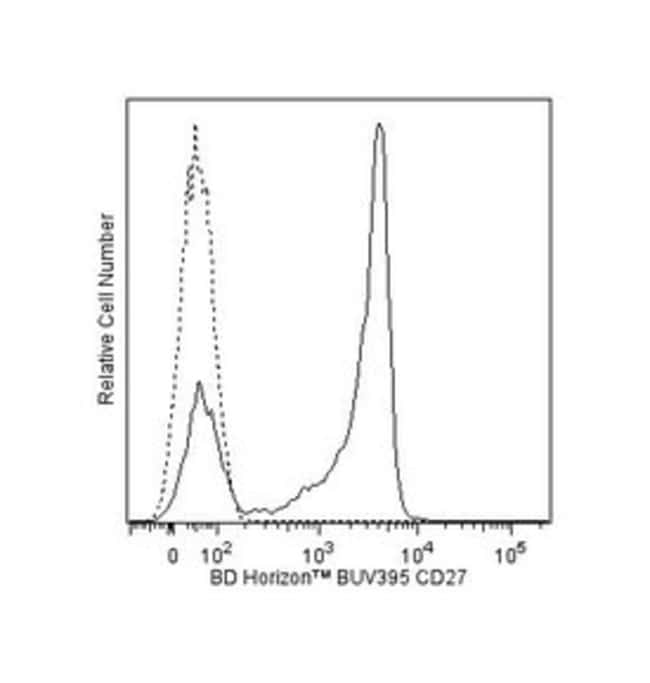
CD27 Mouse anti-Human, BUV395, Clone: L128, BD
Description
The L128 monoclonal antibody specifically binds to human CD27. CD27 is a 55-kDa disulfide-linked dimer that is a member of the nerve growth factor (NGF) super family. This family also includes CD40, rat OX40, tumor necrosis factor (TNF) receptors and CD95 (Fas). With its ligand CD70, CD27 acts in a co-stimulatory fashion on T lymphocytes. Present on most peripheral blood T lymphocytes and medullary thymocytes, the CD27 antigen is upregulated upon activation with the release of a soluble form, 28 to 32 kDa. It is also detected on a subpopulation of approximately 33% of circulating B lymphocytes. Following exposure to antigens, CD45RA+ T lymphocytes respond by upregulating the CD27 antigen. After maximal stimulation, the CD27 antigen cannot be re-expressed on long-term cultures or on CD45RA-CD27+ T lymphocytes. The CD4+CD27- population is contained within the memory CD45RO+ subset that proliferates after exposure to allergens. Two subpopulations of B lymphocytes bearing the CD27 antigen secrete IgM ( δ +) and IgG ( δ -).

Specifications
Specifications
| Antigen | CD27 |
| Applications | Flow Cytometry |
| Classification | Monoclonal |
| Clone | L128 |
| Conjugate | Brilliant Ultraviolet 395 |
| Description | TNFRSF7; Tumor necrosis factor receptor superfamily, member 7; Tp55; S152 |
| Formulation | Aqueous buffered solution containing BSA and ≤0.09% sodium azide. |
| Host Species | Mouse |
| Immunogen | Human Activated Peripheral Blood Cells |
| Purification Method | Affinity Purified |
| Show More |
For Research Use Only.
By clicking Submit, you acknowledge that you may be contacted by Fisher Scientific in regards to the feedback you have provided in this form. We will not share your information for any other purposes. All contact information provided shall also be maintained in accordance with our Privacy Policy.