Learn More
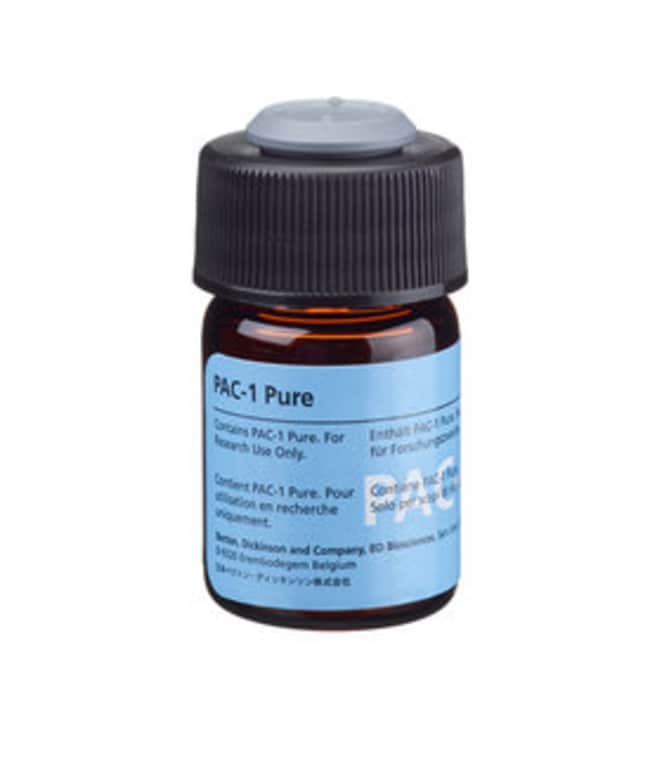
PAC-1 Mouse anti-Human, Unlabeled, Clone: PAC-1, BD
Description
PAC-1 recognizes an epitope on the glycoprotein IIb/IIIa (gpIIb/IIIa, aIIbb3) complex of activated platelets at or near the platelet fibrinogen receptor. The gpIIb/IIIa complex is a member of a family of heterodimeric adhesive protein receptors found on a variety of cell types that have been named the integrin or the cytoadhesion family.The gpIIb/IIIa complex is located on the surface membrane of resting platelets. Platelet activation induces a calcium-dependent conformational change in gpIIb/IIIa that exposes a ligand binding site. Four adhesive macromolecules are capable of interacting with the activated form of gpIIb/IIIa: fibrinogen, von Willebrand factor (vWf), fibronectin, and vitronectin. The binding of fibrinogen to the gpIIb/IIIa receptor is required for platelet aggregation. PAC-1 binds only to activated platelets and appears to be specific for this recognition site within gpIIb/IIIa. Approximately 45,000 to 50,000 gpIIb/IIIa receptors appear on the platelet surface upon activation. PAC-1 inhibits fibrinogen- mediated platelet aggregation.
Flow Cytometry, Immunohistochemistry

Specifications
Specifications
| Antigen | PAC-1 |
| Applications | Flow Cytometry |
| Classification | Monoclonal |
| Clone | PAC-1 |
| Concentration | 1mg/mL |
| Conjugate | Unconjugated |
| Formulation | Phosphate buffered saline with 0.01% sodium azide. |
| Host Species | Mouse |
| Immunogen | Human platelets |
| Purification Method | Affinity Purified |
| Show More |
For Research Use Only.
By clicking Submit, you acknowledge that you may be contacted by Fisher Scientific in regards to the feedback you have provided in this form. We will not share your information for any other purposes. All contact information provided shall also be maintained in accordance with our Privacy Policy.