missing translation for 'onlineSavingsMsg'
Learn More
Learn More
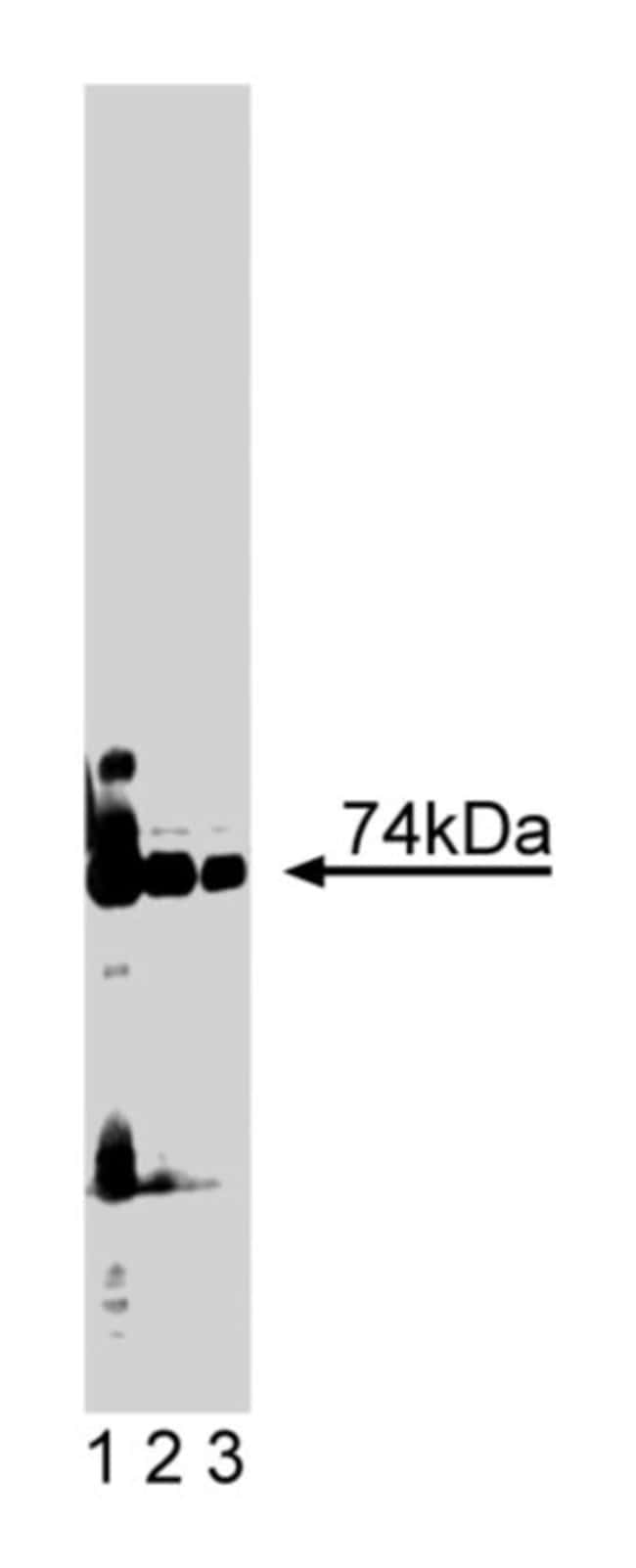

PKCλ Mouse, Unlabeled, Clone: 41, BD
Mouse Monoclonal Antibody
€ 178.69 - € 450.58
Specifications
| Antigen | PKCλ |
|---|---|
| Clone | 41 |
| Concentration | 250μg/mL |
| Applications | Western Blot |
| Classification | Monoclonal |
| Product Code | Brand | Quantity | Price | Quantity & Availability | |||||
|---|---|---|---|---|---|---|---|---|---|
| Product Code | Brand | Quantity | Price | Quantity & Availability | |||||
|
15895329
|
BD Biosciences
610207 |
50 μg |
 € 179.00 € 178.69 / 1 set Save € 0.31 0.17% Off |
Please sign in to purchase this item. Need a web account? Register with us today! | |||||
|
15805339
|
BD Biosciences
610208 |
150 μg |
€ 451.00 € 450.58 / 1 set Save € 0.42 0.09% Off |
Please sign in to purchase this item. Need a web account? Register with us today! | |||||
Description
The Protein Kinase C (PKC) family of homologous serine/threonine protein kinases is involved in a number of processes such as growth, differentiation, and cytokine secretion. At least eleven isozymes have been described. These proteins are products of multiple genes and alternative splicing. PKC consists of a single polypeptide chain containing four conserved regions (C) and five variable regions (V). The N-terminal half containing C1, C2, V1, and V2 constitutes the regulatory domain and interacts with the PKC activators Ca2+, phospholipid, diacylglycerol, or phorbol ester. However, the novel PKC (nPKC) subfamily members ( δ, ε, η, and θ isoforms) and the atypical PKC (aPKC) subfamily members (ζ, ι, and λ isoforms) are Ca2+ independent and lack the C2 domain. The aPKC members are unique in that their activity is independent of diacylglycerols and phorbol esters. They also lack one repeat of the cysteine-rich sequences that are conserved in cPKC and nPKC. The C-terminal region of PKC contains the catalytic domain. The PKC pathway represents a major signal transduction system that is activated following ligand-stimulation of transmembrane receptors by hormones, neurotransmitters, and growth factors. PKC? shows the highest degree of amino acid homology with PKCζ (72%) and PKCλ mRNA is expressed in a variety of cells and tissues. The PKCλ protein kinase is capable of autophosphorylation and can be activated by phosphatidylserine, but not by other PKC activators such as diacylglycerols, Ca2+, or phorbol esters.
Immunofluorescence, Immunohistochemistry, Immunoprecipitation, Western Blotting
Specifications
| PKCλ | |
| 250μg/mL | |
| Monoclonal | |
| Mouse | |
| Cell Biology | |
| Aqueous buffered solution containing BSA, glycerol, and ≤0.09% sodium azide. | |
| IgG1 | |
| Affinity Purified |
| 41 | |
| Western Blot | |
| Unconjugated | |
| RUO | |
| Canine, Chicken, Human, Mouse, Rat | |
| Human PKCγ aa. 397-558 | |
| Primary | |
| Store undiluted at -20°C. |
For Research Use Only.
Spot an opportunity for improvement?Share a Content Correction
Product Content Correction
Your input is important to us. Please complete this form to provide feedback related to the content on this product.
Product Title