missing translation for 'onlineSavingsMsg'
Learn More
Learn More

This item is not returnable.
View return policy
Description
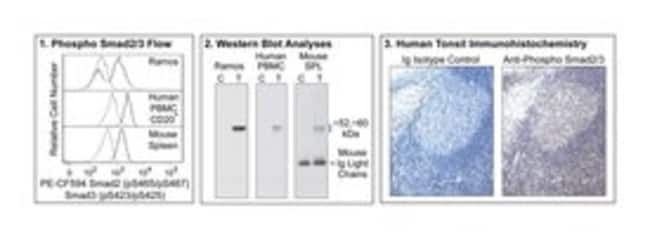
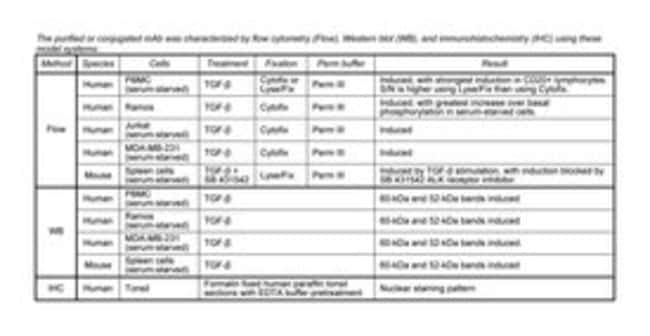
The O72-670 monoclonal antibody specifically binds to the Smad2 protein phosphorylated at the Ser465/467 sites and the Smad3 protein phosphorylated at the Ser423/425 sites. Smad2 and Smad3 are members of the Smad superfamily with observed molecular weights of 60 kDa and 52 kDa, respectively. The Smad family consists of three subfamilies: receptor regulated Smads or R-Smads, including Smads1, 2, 3, 5, and 8; common partner Smad, or Co-Smad, including Smad4; and inhibitory Smads, or I-Smad, including Smads 6 and 7. Activation of TGF-beta superfamily serine/threonine kinase receptors, such as TGF-beta, activin and BMP receptors, by their bound ligands leads to the phosphorylation of R-Smads at several sites. It has been shown that the ligand-bound TGF-beta type I receptor directly phosphorylates Ser465 and Ser467 of Smad2 and Ser423 and Ser425 of Smad3. Phosphorylated R-Smads form complexes with Co-Smad and translocate into the nucleus to regulate transcription affecting a wide range of critical cellular processes including cell-fate determination, proliferation, morphogenesis, differentiation and apoptosis. The inhibitory Smads inhibit this pathway through two potential mechanisms: either by preventing R-Smads from binding to their corresponding receptors and/or by competing with Smad4, the Co-Smad, from binding to R-Smads. High level expression of phosphorylated Smad2 has been associated with poor prognosis in late stage gastric carcinoma. Roles for Smad2 have been described in thymopoiesis and the TGF-β-mediated induction of regulatory T cells and Th17 cells. The specificity of theO72-670 mAb was confirmed by Western blot and immunohistochemistry using unconjugated antibody.
This antibody is conjugated to BD Horizon™ PE-CF594, which has been developed exclusively by BD Biosciences as a better alternative to PE-Texas Red™. PE-CF594 excites and emits at similar wavelengths to PE-Texas Red™ yet exhibits improved brightness and spectral characteristics. Due to PE having maximal absorption peaks at 496nm and 564nm, PE-CF594 can be excited by the blue (488-nm), green (532-nm) and yellow-green (561-nm) lasers and can be detected with the same filter set as PE-Texas Red™ (eg 610/20-nm filter).

Specifications
| Smad2 (pS465/pS467)/Smad3 (pS423/pS425) | |
| Monoclonal | |
| PE-CF594 | |
| Aqueous buffered solution containing BSA and ≤0.09% sodium azide. | |
| Phosphorylated Human Smad2 Peptide | |
| 50 Tests | |
| Primary | |
| Store undiluted at 4°C and protected from prolonged exposure to light. Do not freeze. |
| Flow Cytometry | |
| O72-670 | |
| SMAD2, SMAD3; MADH2, MADH3; MAD homolog 2, MAD homolog 3 | |
| Mouse | |
| Affinity Purified | |
| RUO | |
| Human, Mouse | |
| IgG1 κ |
Product Content Correction
Your input is important to us. Please complete this form to provide feedback related to the content on this product.
Product Title
Spot an opportunity for improvement?Share a Content Correction