missing translation for 'onlineSavingsMsg'
Learn More
Learn More
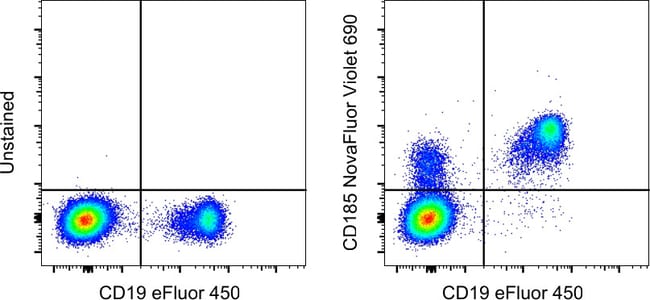
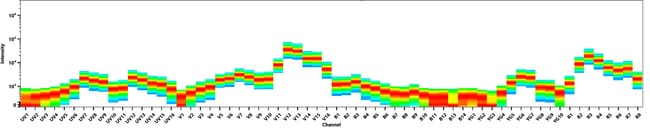
Invitrogen™ CD185 (CXCR5) Monoclonal Antibody (MU5UBEE), NovaFluor™ Violet 690, eBioscience™
Mouse Monoclonal Antibody
Brand: Invitrogen™ H037T03V01-A
This item is not returnable.
View return policy
Description
Description: The MU5UBEE monoclonal antibody reacts with human and non-human primate CD185. The MU5UBEE monoclonal antibody also crossreacts with Rhesus macaque. This product contains 1 vial of NovaFluor conjugate and 1 vial of CellBlox Plus Blocking Buffer. Applications Tested: This MU5UBEE antibody has been pre-titrated and tested by flow cytometric analysis of normal human peripheral blood cells. This can be used at 5 μL (0.6 μg) per test. A test is defined as the amount (μg) of antibody that will stain a cell sample in a final volume of 100 μL. Cell number should be determined empirically but can range from 10^5 to 10^8 cells/test Master mixes. Whole Blood compatibility: When utilizing whole blood (as opposed to density-gradient-purified PBMC), we recommend lysing red blood cells in bulk prior to staining with NovaFluor conjugates. Staining of whole blood with NovaFluor conjugates followed by lysis of red blood cells may result in higher-than-expected background staining.
CD185, also known as CXCR5 or Burkitt lymphoma receptor 1 (BLR1), is a seven-transmembrane G protein-coupled receptor in the CXC chemokine receptor family. It plays a crucial role in lymphocyte trafficking, particularly in T cell migration into B cell follicles of germinal centers in response to CXCL13, making it a key marker of follicular helper T cells. In peripheral blood, CXCR5 is expressed on B cells, CD4+ T cells (excluding Th1 and Th2 cells), and a subset of memory (CD45RO+) T cells. These CD185+ T cells are in a resting state and migrate to lymph nodes due to CCR7 and CD62L expression. In tonsils, CD185 is found on nearly all CD4+ cells, along with activation markers like CD69 and ICOS, and can induce antibody production when co-cultured with B cells. CXCR5 is expressed in lymphatic tissues such as lymph node follicles and the spleen, and is also found in human blood and salivary glands, as well as various animal tissues. It is essential for B cell migration and is part of the larger family of G protein-coupled receptors (GPCRs), which have seven membrane-spanning helices and are involved in numerous signaling pathways. GPCRs, including CXCR5, are regulated by various ligands that affect their conformation and signaling through G-proteins and downstream effectors. The regulation of GPCRs, including their deactivation, has significant implications for cellular functions and is a major focus of pharmacological research, leading to the development of drugs like Zyprexa and Claritin for mental health and allergy treatments.
Specifications
| CD185 (CXCR5) | |
| Monoclonal | |
| 0.6 μg/Test | |
| PBS with BSA and 0.09% sodium azide; pH 7.2 | |
| P32302 | |
| CXCR5 | |
| Affinity chromatography | |
| RUO | |
| 643, 701792 | |
| 4°C, store in dark, DO NOT FREEZE! | |
| Liquid |
| Flow Cytometry | |
| MU5UBEE | |
| NovaFluor Violet 690 | |
| CXCR5 | |
| Blr1; Blr-1; Burkitt lymphoma receptor 1; burkitt lymphoma receptor 1 homolog; Burkitt lymphoma receptor 1, GTP binding protein (chemokine (C-X-C motif) receptor 5); Burkitt lymphoma receptor 1, GTP-binding protein; C Cmotif chemokine; C X C motif chemokine; CC motif chemokine; CCmotif chemokine; CD185; CD185 antigen; chemochine (C-X-C motif) receptor 5; chemokine (C-X-C motif) receptor 5; CXC; C-X-C chemokine receptor type 5; CXC motif chemokine; C-X-C motif chemokine receptor 5; CXCR5; CXC-R5; CXCR-5; EGK_06966; Fusin; Gpcr6; GPR9; HUMSTR; LESTR; MDR15; MDR-15; Monocyte-derived receptor 15; neurolymphatic receptor; NLR | |
| Mouse | |
| 100 Tests | |
| Primary | |
| Human, Monkey, Rhesus Macaque | |
| Antibody | |
| IgG2b κ |
Product Content Correction
Your input is important to us. Please complete this form to provide feedback related to the content on this product.
Product Title
Spot an opportunity for improvement?Share a Content Correction