missing translation for 'onlineSavingsMsg'
Learn More
Learn More
Invitrogen™ CD23 Monoclonal Antibody (B3B4), Brilliant Ultra Violet™ 805, eBioscience™, Invitrogen™

Rat Monoclonal Antibody
€ 193.00 - € 389.00
Specifications
| Antigen | CD23 |
|---|---|
| Clone | B3B4 |
| Concentration | 0.2 mg/mL |
| Applications | Flow Cytometry |
| Classification | Monoclonal |
| Product Code | Brand | Quantity | Price | Quantity & Availability | |||||
|---|---|---|---|---|---|---|---|---|---|
| Product Code | Brand | Quantity | Price | Quantity & Availability | |||||
|
17453482
|
Invitrogen™
368-0232-82 |
100 μg |
€ 389.00
100µg |
Please sign in to purchase this item. Need a web account? Register with us today! | |||||
|
17443482
|
Invitrogen™
368-0232-80 |
25 μg |
€ 193.00
25µg |
Please sign in to purchase this item. Need a web account? Register with us today! | |||||
Description
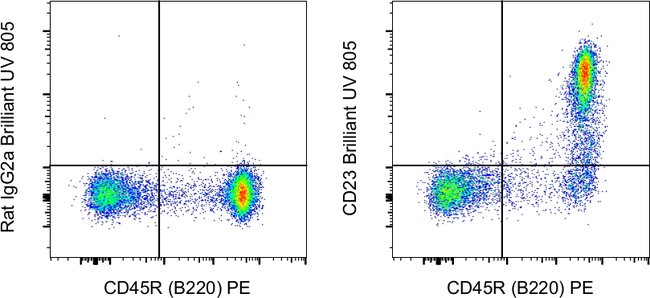
The B3B4 monoclonal antibody reacts with mouse CD23, a 45 kDa type II transmembrane glycoprotein. CD23 is expressed on resting conventional B cells, and its expression is modulated upon B-cell activation. B-1 cell lineage (CD5+ B cells) does not express CD23. Soluble forms of the antigen have been reported to be biologically active. CD23 is a low affinity receptor for IgE and is thought to play a role in the regulation of IgE response and B-cell activation. CD21 is thought to bind to CD23. Applications Reported: This B3B4 antibody has been reported for use in flow cytometric analysis. Applications Tested: This B3B4 antibody has been tested by flow cytometric analysis of mouse splenocytes. This may be used at less than or equal to 1.0 μg per test. A test is defined as the amount (μg) of antibody that will stain a cell sample in a final volume of 100 μL. Cell number should be determined empirically but can range from 10^5 to 10^8 cells/test. It is recommended that the antibody be carefully titrated for optimal performance in the assay of interest. Brilliant Ultraviolet 805 is a tandem dye that emits at 797 nm and is intended for use on cytometers equipped with an ultraviolet (355 nm) laser.
CD23 is a 45 kDa glycoprotein which is present on a subpopulation of freshly isolated peripheral blood and tonsil B cells and strongly expressed on EBV-transformed B lymphoblasts. The CD23 molecule is identical to the low affinity IgE receptor found on B cells. Expression of CD23 has been detected in neoplastic cells from cases of B cell chronic lymphocyctic leukaemia and some cases of centroblastic/centrocytic lymphoma. CD23 is present on a subpopulation of freshly isolated peripheral blood and tonsil B cells and strongly expressed on EBV-transformed B lymphoblasts. Functionally, CD23 is involved in B cell growth and differentiation, and IgE production. Further, CD23 has a soluble form that is a potent mitogenic factor. Diseases associated with CD23 dysfunction include chronic conjunctivitis and chronic lymphocytic leukemia.Specifications
| CD23 | |
| 0.2 mg/mL | |
| Monoclonal | |
| Liquid | |
| RUO | |
| P20693 | |
| 14128 | |
| IgG2a κ | |
| Affinity chromatography | |
| Fcer2a |
| B3B4 | |
| Flow Cytometry | |
| Brilliant Ultraviolet 805 | |
| Rat | |
| Mouse | |
| BLAST-2; CD23; CD23 antigen; CD23A; CLEC4J; C-type lectin domain family 4 member J; C-type lectin domain family 4, member J; Fc epsilon receptor II; FC epsilon RII; Fc fragment of IgE receptor II; Fc fragment of IgE, low affinity II, receptor for (CD23); Fc receptor alpha multiple ligand receptor; Fc receptor, IgE, low affinity II, alpha polypeptide; Fcalpha muR; Fcalpha RII; Fce2; fc-epsilon-RII; FCER2; Fcer2a; FceRII; IGEBF; Immunoglobulin E-binding factor; immunoglobulin epsilon-chain; low affinity immunoglobulin epsilon Fc receptor; Low affinity immunoglobulin epsilon Fc receptor membrane-bound form; Low affinity immunoglobulin epsilon Fc receptor soluble form; low-affinity IgE receptor; Ly-42; lymphocyte IgE receptor | |
| Fcer2a | |
| Primary | |
| Antibody |
Spot an opportunity for improvement?Share a Content Correction
Product Content Correction
Your input is important to us. Please complete this form to provide feedback related to the content on this product.
Product Title