missing translation for 'onlineSavingsMsg'
Learn More
Learn More
Invitrogen™ CD321 (F11R) Monoclonal Antibody (WK9), APC, eBioscience™

Mouse Monoclonal Antibody
€ 293.00
Specifications
| Antigen | CD321 (F11R) |
|---|---|
| Clone | WK9 |
| Concentration | 5 μL/Test |
| Content And Storage | 4°C, store in dark, DO NOT FREEZE! |
| Applications | Flow Cytometry |
Description
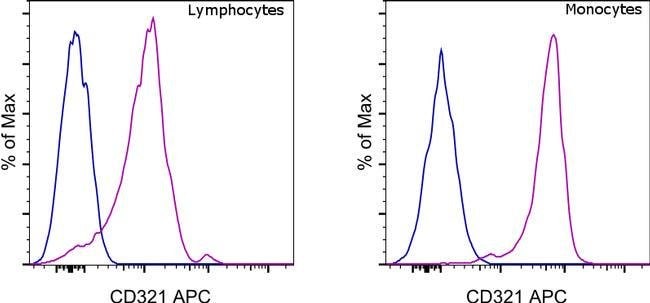
Description: CD321 (F11R, JAM-1, JAM-A) is a cell-surface adhesion molecule belonging to the Ig superfamily of receptors. CD321 is a 32-41 kD glycoprotein, possessing two extracellular Ig-like domains, a transmembrane region, and a short cytosolic tail. The protein assembles at the membrane as a homodimer, and can associate laterally with other membrane proteins including integrins. CD321 is expressed on a variety of cell types, including leukocytes, platelets, erythrocytes, epithelial and endothelial cells, and plays a role in mediating cell-cell contact. CD321 can be found in close proximity to several components of epithelial tight junctions, including ZO-1 and occludin. CD321 is also involved in reovirus entry into cells. Applications Reported: This WK9 antibody has been reported for use in flow cytometric analysis. Applications Tested: This WK9 antibody has been pre-diluted and tested by flow cytometric analysis of normal human peripheral blood cells. This may be used at 5 μL (0.25 μg) per test. A test is defined as the amount (μg) of antibody that will stain a cell sample in a final volume of 100 μL. Cell number should be determined empirically but can range from 10^5 to 10^8 cells/test. Excitation: 633-647 nm; Emission: 660 nm; Laser: Red Laser.
CD321 (F11R, JAM-1, JAM-A) is a cell-surface adhesion molecule belonging to the Ig superfamily of receptors. CD321 is a 32-41 kD glycoprotein, possessing two extracellular Ig-like domains, a transmembrane region, and a short cytosolic tail. The protein assembles at the membrane as a homodimer, and can associate laterally with other membrane proteins including integrins. CD321 is expressed on a variety of cell types, including leukocytes, platelets, erythrocytes, stem cells, epithelial and endothelial cells, and plays a role in mediating cell-cell contact. CD321 can be found in close proximity to several components of epithelial tight junctions, including ZO-1 and occludin. CD321 is involved in the maintenance of epithelial and endothelial barriers, hematopoiesis, angiogenesis, and tumor proliferation, invasion, and metastasis.Specifications
| CD321 (F11R) | |
| 5 μL/Test | |
| Flow Cytometry | |
| APC | |
| Mouse | |
| RUO | |
| PBS with BSA and 0.09% sodium azide; pH 7.2 | |
| Q9Y624 | |
| 50848 | |
| Primary | |
| Affinity chromatography |
| WK9 | |
| 4°C, store in dark, DO NOT FREEZE! | |
| Monoclonal | |
| Liquid | |
| IgG1 κ | |
| Human | |
| F11r | |
| 9130004G24; AA638916; BV11 antigen; CD321; ESTM33; F11 R; F11 receptor; F11 receptor/F11R; F11R; JAM; JAM1; JAM-1; JAMA; JAM-A; Jcam; Jcam1; junction cell adhesion molecule A; junction cell adhesion molecule1; junctional adhesion molecule 1; Junctional adhesion molecule A; KAT; Ly106; PAM-1; Platelet adhesion molecule 1; platelet F11 receptor; UNQ264/PRO301 | |
| F11r | |
| Antibody |
Spot an opportunity for improvement?Share a Content Correction
Product Content Correction
Your input is important to us. Please complete this form to provide feedback related to the content on this product.
Product Title