missing translation for 'onlineSavingsMsg'
Learn More
Learn More
Invitrogen™ CD357 (AITR/GITR) Monoclonal Antibody (DTA-1), PE-Cyanine7, eBioscience™

Rat Monoclonal Antibody
€ 380.00
Specifications
| Antigen | CD357 (AITR/GITR) |
|---|---|
| Clone | DTA-1 |
| Concentration | 0.2 mg/mL |
| Content And Storage | 4°C, store in dark, DO NOT FREEZE! |
| Applications | Flow Cytometry |
Description
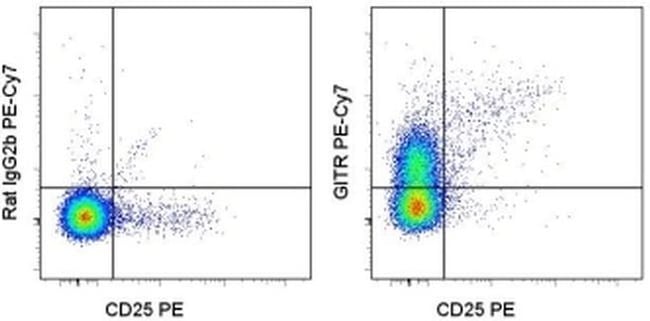
Description: The DTA-1 monoclonal antibody reacts with mouse GITR, Glucocorticoid-Induced TNFR family gene, also known as TNFRSF18. In naive mice, GITR is expressed predominantly by CD4+CD25+ T regulatory cells (Treg) and by CD25+ CD4+ CD8- thymocytes. Stimulation of GITR with DTA-1 antibody abrogates Treg cell-mediated suppression. Although it does not deplete CD357 expressing cells in vivo, it has been shown to induce tumorogenesis. The removal of GITR-expressing Treg cells or the administration of DTA-1 resulted in organ specific autoimmune disease. Applications Reported: This DTA-1 antibody has been reported for use in flow cytometric analysis. Applications Tested: This DTA-1 antibody has been tested by flow cytometric analysis of mouse splenocytes. This can be used at less than or equal to 0.06 μg per test. A test is defined as the amount (μg) of antibody that will stain a cell sample in a final volume of 100 μL. Cell number should be determined empirically but can range from 10^5 to 10^8 cells/test. It is recommended that the antibody be carefully titrated for optimal performance in the assay of interest. Light sensitivity: This tandem dye is sensitive photo-induced oxidation. Please protect this vial and stained samples from light. Fixation: Samples can be stored in IC Fixation Buffer (Product # 00-822-49) (100 μL cell sample + 100 μL IC Fixation Buffer) or 1-step Fix/Lyse Solution (Product # 00-5333-54) for up to 3 days in the dark at 4°C with mi...
Tumor necrosis factor receptor superfamily member 18 (TNFRSF18), also called GITR or AITR is a protein that in humans is encoded by the TNFRSF18 gene. It is mapped to 1p36.33. This gene encodes a member of the TNF-receptor superfamily. The encoded receptor has been shown to have increased expression upon T-cell activation, and it is thought to play a key role in dominant immunological self-tolerance maintained by CD25 (+)CD4 (+) regulatory T cells. Knockout studies in mice also suggest the role of this receptor is in the regulation of CD3-driven T-cell activation and programmed cell death. Three alternatively spliced transcript variants of this gene encoding distinct isoforms have been reported.Specifications
| CD357 (AITR/GITR) | |
| 0.2 mg/mL | |
| Flow Cytometry | |
| PE-Cyanine7 | |
| Rat | |
| RUO | |
| PBS with 0.09% sodium azide; pH 7.2 | |
| O35714 | |
| 21936 | |
| Primary | |
| Affinity chromatography |
| DTA-1 | |
| 4°C, store in dark, DO NOT FREEZE! | |
| Monoclonal | |
| Liquid | |
| IgG2b κ | |
| Mouse | |
| Tnfrsf18 | |
| Activation-inducible TNFR family receptor; AITR; CD357; GITR; GITR-D; glucocorticoid-induced TNFR-related protein; PRO364; TNF receptor superfamily activation-inducible protein; TNF receptor superfamily member 18; TNFRSF18; Tumor necrosis factor receptor superfamily member 18; tumor necrosis factor receptor superfamily, member 18; UNQ319; UNQ319/PRO364 | |
| Tnfrsf18 | |
| Antibody |
Spot an opportunity for improvement?Share a Content Correction
Product Content Correction
Your input is important to us. Please complete this form to provide feedback related to the content on this product.
Product Title