missing translation for 'onlineSavingsMsg'
Learn More
Learn More
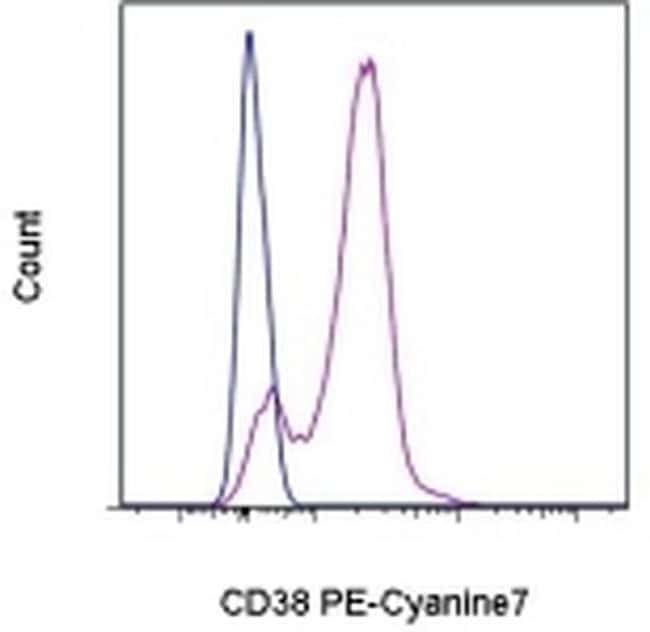
Invitrogen™ CD38 Monoclonal Antibody (HB7), PE-Cyanine7, eBioscience™, Invitrogen™

Mouse Monoclonal Antibody
€ 141.00 - € 347.00
Specifications
| Antigen | CD38 |
|---|---|
| Clone | HB7 |
| Concentration | 5 μL/Test |
| Applications | Flow Cytometry |
| Classification | Monoclonal |
| Product Code | Brand | Quantity | Price | Quantity & Availability | |||||
|---|---|---|---|---|---|---|---|---|---|
| Product Code | Brand | Quantity | Price | Quantity & Availability | |||||
|
15548396
|
Invitrogen™
25-0388-42 |
100 Tests |
€ 347.00
100 tests |
Please sign in to purchase this item. Need a web account? Register with us today! | |||||
|
15538396
|
Invitrogen™
25-0388-41 |
25 Tests |
€ 141.00
25 tests |
Please sign in to purchase this item. Need a web account? Register with us today! | |||||
Description
The HB7 MAb reacts with the human CD38 molecule, an approximately 45 kDa type II transmembrane protein. CD38 is an ectoenzyme which catalyses NAD into nicotinic acid adenine dinucleotide phosphate (NAADP) and cyclic ADP-ribose (cADPR), both of which are secondary messengers. Expression of CD38 is bimodal during B cell development, modulating from high in immature cells to low in intermediate ones and back to high on mature B cells. Additionally CD38 is found in a variety of tissues and other hematopoietic cells (e.g. T cells, NK cells and monocytes) and can be used to phenotype leukemias and monitor HIV-1 progression. The CD34+CD38- population of hematopoietic stems cells is thought to define the most pluripotent cells (e.g. blast colony forming cells). In addition to surface expression, CD38 has recently been found in the nucleus where it may play a role in monitoring calcium levels.
CD38 (NAD+ glycohydrolase) is a type II transmembrane glycoprotein able to induce activation, proliferation and differentiation of mature lymphocytes and mediate apoptosis of myeloid and lymphoid progenitor cells. CD38 functions as a multi-catalytic ectoenzyme serving as ADP-ribosyl cyclase, cyclic ADP-ribose hydrolase and possibly NAD+ glycohydrolase or as a cell surface receptor. Antibodies to CD38 are useful in subtyping of lymphomas and leukemias, detection of plasma cells (i.e. identification of myelomas), and as a marker for activated B and T cells. CD38 participates in cell adhesion, signal transduction and calcium signaling. Further, CD38 is expressed at high levels in the pancreas, liver, kidney, malignant lymphoma and neuroblastoma. Diseases associated with CD38 dysfunction include chronic lymphocytic leukemia and Richter's Syndrome.Specifications
| CD38 | |
| 5 μL/Test | |
| Monoclonal | |
| Liquid | |
| RUO | |
| P28907 | |
| 952 | |
| IgG1 κ | |
| Affinity chromatography | |
| CD38 |
| HB7 | |
| Flow Cytometry | |
| PE-Cyanine7 | |
| Mouse | |
| Human | |
| 2'-phospho-ADP-ribosyl cyclase; 2'-phospho-ADP-ribosyl cyclase/2'-phospho-cyclic-ADP-ribose transferase; 2'-phospho-cyclic-ADP-ribose transferase; ADPRC 1; ADPRC1; ADP-ribosyl cyclase 1; ADP-ribosyl cyclase/cyclic ADP-ribose hydrolase 1; cADPr hydrolase 1; Cd38; CD38 antigen; CD38 antigen (ADP-ribosyl cyclase / cyclic ADP-ribose hydrolase); CD38 antigen (p45); CD38 antigen p45; CD38 molecule; CD38H; Cd38-rs1; cluster of differentiation 38; cyclic ADP-ribose hydrolase 1; ecto-nicotinamide adenine dinucleotide glycohydrolase; I-19; NAD(+) nucleosidase; NAD+ nucleosidase; NIM-R5 antigen; T10 | |
| CD38 | |
| Primary | |
| Antibody |
Spot an opportunity for improvement?Share a Content Correction
Product Content Correction
Your input is important to us. Please complete this form to provide feedback related to the content on this product.
Product Title