missing translation for 'onlineSavingsMsg'
Learn More
Learn More
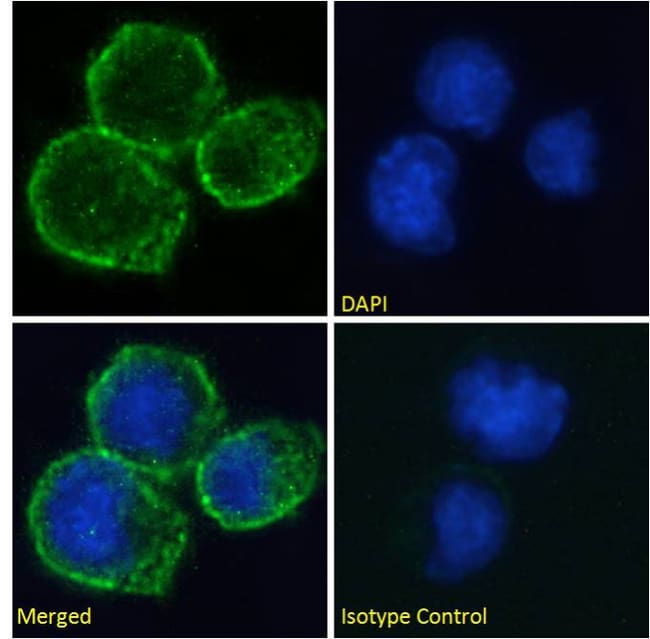
Invitrogen™ CD40 Chimeric Recombinant Rabbit Monoclonal Antibody (A54 scFv)

Rabbit Recombinant Monoclonal Antibody
Brand: Invitrogen™ MA548065
This item is not returnable.
View return policy
Description
Specificity: A54 binds specifically to the D1 domain of CD40 (and can only bind to the intact i.e. non-truncated version of CD40 and when an AD2 peptide tag has not been added) and can recognise CD40 on a B cell line (BJAB). Preparation: A54 human anti-CD40 was selected from the n-CoDeR phage display library after 4 rounds of selections using biotinylated CD40-Fcgamma fusion protein as bait and subsequent capture of bound phages on streptavidin-caoted magnetic beads.
CD40 is a single-chain glycoprotein and a member of the tumor necrosis factor receptor (TNFR) family, exhibiting significant homology to the Hodgkin's disease-associated antigen, CD30. It is expressed by B lymphocytes, follicular dendritic cells, thymic epithelium, and a subset of peripheral T cells, as well as some epithelial cells, carcinomas, and lymphoid dendritic cells. Notably, CD40 is present on all B cells except plasma cells. CD40 plays a crucial role in regulating B cell development and maturation, inducing immunoglobulin isotype-switching, and protecting B cells from surface Ig-induced apoptosis when combined with other signals such as IL-4. It promotes proliferation and is essential for T cell-dependent immunoglobulin class switching, memory B cell development, and germinal center formation. The interaction between CD40 and its ligand CD154 (gp39) on T cells is vital for T-B cell crosstalk, costimulation, and immune regulation. Adaptor protein TNFR2 interacts with CD40, mediating signal transduction, while the AT-hook transcription factor AKNA is reported to regulate CD40 expression, which may be important for homotypic cell interactions. Additionally, the interaction between CD40 and its ligand is necessary for amyloid-beta-induced microglial activation, suggesting a role in the early pathogenesis of Alzheimer's disease. Two alternatively spliced transcript variants encoding distinct isoforms of CD40 have been identified. Diseases associated with CD40 dysfunction include Type 3 Hyper-IgM immunodeficiency and CD40 ligand deficiency, highlighting its importance in immune and inflammatory responses.
Specifications
| CD40 Chimeric | |
| Recombinant Monoclonal | |
| 1 mg/mL | |
| PBS with 0.02% ProClin 300 | |
| P25942 | |
| CD40 | |
| A54 human anti-CD40 scFv was selected from the n-CoDeR phage display library after 4 rounds of selections using biotinylated CD40-Fcgamma fusion protein as bait and subsequent capture of bound phages on streptavidin-caoted magnetic beads. | |
| 200 μg | |
| Primary | |
| Human | |
| Antibody | |
| IgG λ |
| ELISA, Inhibition Assays, T-Cell Activation, Immunocytochemistry | |
| A54 scFv | |
| Unconjugated | |
| CD40 | |
| AI326936; B cell surface antigen CD40; B cell-associated molecule; B-cell surface antigen CD40; Bp50; CD antigen CD40; Cd40; CD40 antigen; CD40 antigen (TNF receptor superfamily member 5); CD40 antigen, TNF receptor superfamily member 5; CD40 molecule; CD40 molecule, TNF receptor superfamily member 5; CD40L receptor; CDw40; GP39; HIGM1; I79_006806; IGM; IMD3; Immunoglobulin M; ImmunoglobulinM; membrane protein CD40; MGC9013; p50; receptor for ligand CD154; sCD40; soluble CD40; T-BAM; T-cell differentiation antigen; Tnfrsf5; TRAP; tumor necrosis factor receptor superfamily member 5; tumor necrosis factor receptor superfamily, member 5 | |
| Rabbit | |
| Protein A | |
| RUO | |
| 958 | |
| Store at 4°C short term. For long term storage, store at -20°C, avoiding freeze/thaw cycles. | |
| Liquid | |
| Tag |
Product Content Correction
Your input is important to us. Please complete this form to provide feedback related to the content on this product.
Product Title
Spot an opportunity for improvement?Share a Content Correction