Learn More
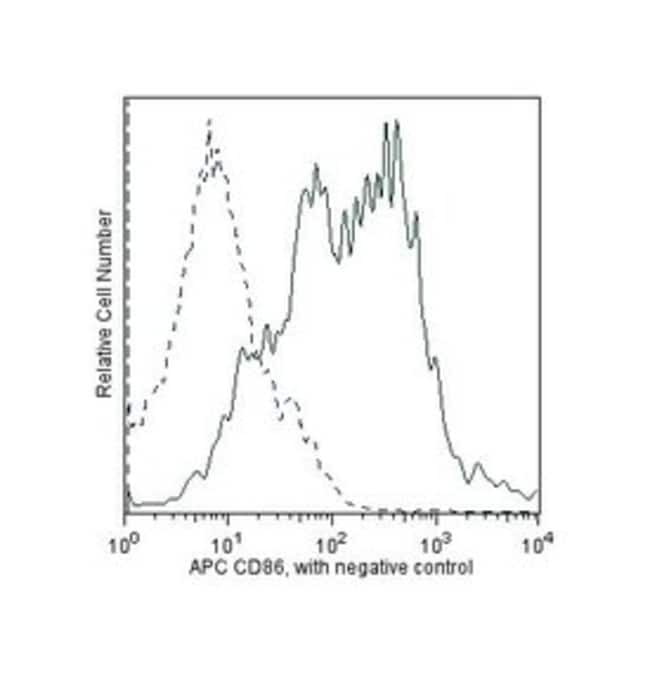
CD86 Rat anti-Mouse, APC, Clone: GL1, BD
Description
The GL1 antibody has been reported to react with the B7-2 (CD86) costimulatory molecule expressed on a broad spectrum of leukocytes, including B lymphocytes, T lymphocytes, thioglycollate-induced peritoneal macrophages, dendritic cells and astrocytes. CD86 is expressed at low levels by freshly explanted peripheral B and T cells, and its expression is substantially increased by a variety of T cell- and B cell-specific stimuli with a peak expression after 18-42 hours of culture. In contrast to most naive CD4+ T cells, memory CD4+ T cells express B7-2, both at the mRNA and protein level. CD86, a ligand for CD28 and CD152 (CTLA-4), is one of the accessory molecules that plays an important role in T cell-B cell costimulatory interactions. It has been shown to be involved in immunoglobulin class-switching and triggering of mouse NK cell-mediated cytotoxicity. CD80 (B7-1) is an alternate ligand for CD28 and CD152 (CTLA-4). GL1 antibody reportedly blocks MLR and stimulation of T cells by natural antigen-presenting cells. In addition, a mixture of anti-B7-1 and anti B7-2 (GL1) mAbs reportedly inhibits the in vitro interaction of CTLA-4 with its ligand and the in vivo priming of cytotoxic T lymphocytes.

Specifications
Specifications
| Antigen | CD86 |
| Applications | Flow Cytometry |
| Classification | Monoclonal |
| Clone | GL1 |
| Concentration | 0.2mg/mL |
| Conjugate | APC |
| Description | B7-2; Ly-58; Cd28l2; Early T-cell costimulatory molecule 1; ETC1; MB7; CLS1 |
| Formulation | Aqueous buffered solution containing ≤0.09% sodium azide. |
| Host Species | Rat |
| Immunogen | Mouse (CBA/Ca) LPS-activated splenic B Cells |
| Show More |
For Research Use Only.
By clicking Submit, you acknowledge that you may be contacted by Fisher Scientific in regards to the feedback you have provided in this form. We will not share your information for any other purposes. All contact information provided shall also be maintained in accordance with our Privacy Policy.