missing translation for 'onlineSavingsMsg'
Learn More
Learn More
Invitrogen™ CD9 Monoclonal Antibody (eBioKMC8 (KMC8)), FITC, eBioscience™
Rat Monoclonal Antibody
€ 168.00
Specifications
| Antigen | CD9 |
|---|---|
| Clone | eBioKMC8 (KMC8) |
| Concentration | 0.5 mg/mL |
| Content And Storage | 4°C, store in dark, DO NOT FREEZE! |
| Applications | Flow Cytometry |
Description
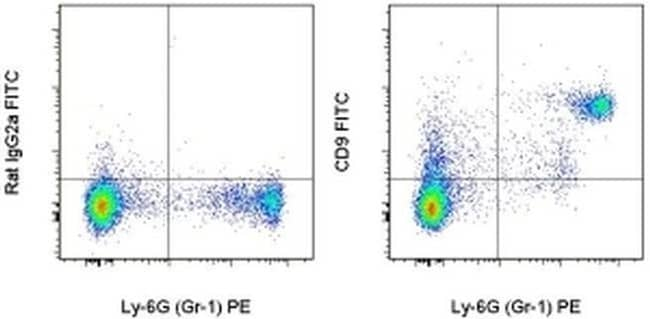
Description: The eBioKMC8 monoclonal antibody reacts with mouse CD9, a 24 kDa member of the transmembrane 4 superfamily. This family is characterized by the presence of four hydrophobic domains spanning the cell membrane and short N- and C-terminal cytoplasmic domains. CD9 is expressed by several cell types including monocytes, macrophages, platelets, early B cells, activated B and T cells, dendritic cells, eosinophils, basophils, endothelial cells, myoblasts and neuroblasts. On T cells, CD9 functions as a co-stimulatory molecule on naive T cells. Furthermore, CD9 is expressed in oocytes, and CD9-deficiency results in sterility caused by defective gamete fusion. In mouse macrophages, CD9 functionally associates with FcgammaRs to modify signals for phagocytosis and inflammatory responses. In mouse B cells, it was discovered that CD9 is a marker for marginal zone B cells, B1 cells, and plasma cells. In dendritic cells, recently it was demonstrated that CD9 facilitates the association of heterologous MHC II molecules. The level of CD9 expression is subject to donor variability. Applications Reported: This eBioKMC8 (KMC8) antibody has been reported for use in flow cytometric analysis. Applications Tested: This eBioKMC8 (KMC8) antibody has been tested by flow cytometric analysis of mouse splenocytes and bone marrow cells. This can be used at less than or equal to 1 μg per test. A test is defined as the amount (μg) of antibody that will stain a cell sample in a final volum...
CD9 antigen is a glycoprotein expressed on the surface of developing B lymphocytes, platelets, monocytes, eosinophils, basophil, stimulated T lymphocytes and by neurons and glial cells in the peripheral nervous system. CD9 belongs to a family of membrane proteins termed tetraspanins which transverse the membrane four times. In pre B cells and platelets, CD9 antigen regulates cell activation and aggregation possibly through an association with the integrin CD41 / CD61 (GPIIb / GPIIIa). CD9 is involved in cell motility, osteoclastogenesis, neurite outgrowth, myotube formation, and sperm-egg fusion, plays roles in cell attachment and proliferation and is necessary for association of heterologous MHC II molecules on the dendritic cell plasma membrane which is important for effective T cell stimulation. CD9 functions in many cellular processes including differentiation, adhesion, and signal transduction, and expression plays a critical role in the suppression of cancer cell motility and metastasis. CD9 is also considered as metastasis suppressor in solid tumors.Specifications
| CD9 | |
| 0.5 mg/mL | |
| Flow Cytometry | |
| FITC | |
| Rat | |
| RUO | |
| PBS with 0.09% sodium azide; pH 7.2 | |
| P40240 | |
| 12527 | |
| Primary | |
| Affinity chromatography |
| eBioKMC8 (KMC8) | |
| 4°C, store in dark, DO NOT FREEZE! | |
| Monoclonal | |
| Liquid | |
| IgG2a κ | |
| Mouse | |
| CD9 | |
| 5H9; 5H9 antigen; antigen CD9; BA2; BA-2/p24 antigen; BTCC-1; CD9; CD9 antigen; CD9 antigen (p24); CD9 molecule; cell growth-inhibiting gene 2 protein; DRAP-27; GIG2; Leukocyte antigen MIC3; MIC3; motility related protein-1; Motility-related protein; MRP-1; p24; sCD 9; sCD9; soluble CD 9; soluble CD9; Tetraspanin29; Tetraspanin-29; transmembrane protein CD9; TSPAN29; Tspan-29 | |
| CD9 | |
| Antibody |
Spot an opportunity for improvement?Share a Content Correction
Product Content Correction
Your input is important to us. Please complete this form to provide feedback related to the content on this product.
Product Title