missing translation for 'onlineSavingsMsg'
Learn More
Learn More
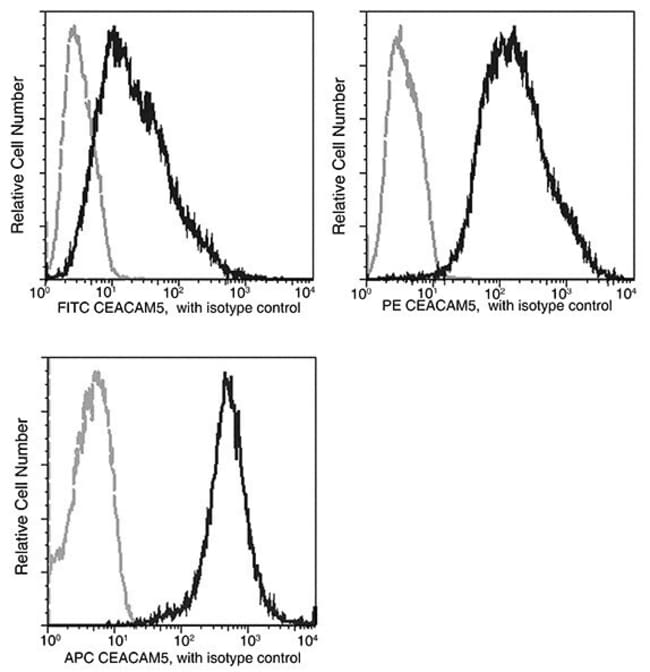
Invitrogen™ CEA Recombinant Rabbit Monoclonal Antibody (061), APC
Rabbit Recombinant Monoclonal Antibody
Brand: Invitrogen™ MA546721
This item is not returnable.
View return policy
Description
Preparation: This antibody was obtained from a rabbit immunized with purified, recombinant Human CD66e (CEACAM5) (Met1-Ala685) and conjugated with APC under optimum conditions, the unreacted APC was removed. Storage: This antibody can be stored at 2C-8C for twelve months without detectable loss of activity. Protected from prolonged exposure to light. Do not freeze! Sodium azide is toxic to cells and should be disposed of properly. Flush with large volumes of water during disposal.
CEA (Carcino Embryonic Antigen, CD66e) is synthesized during development in the fetal gut, and re-expressed in increased amounts in intestinal carcinomas and several other tumors. CEA is a member of carcinoembryonic antigens, immunoglobulin supergene family and consists of a single N domain (structural homology to the immunoglobulin variable) and six immunoglobulin constant-like A (A1, A2, A3) and B domains (B1, B2, B3). Antibodies to CEA are useful in identifying the origin of various metastatic adenocarcinomas and in distinguishing pulmonary adenocarcinomas (60 to 70% are CEA+) from pleural mesotheliomas (rarely or weakly CEA+). CEA is a member of a large family of glycoproteins, a useful tumor marker for adenocarcinoma, and found in adenocarcinomas of endodermally derived digestive system epithelium and fetal colon. Two subgroups of the CEA family, the CEA cell adhesion molecules and the pregnancy-specific glycoproteins, are located within a 1.2 Mb cluster on the long arm of chromosome 19. Eleven pseudogenes of the CEA cell adhesion molecule subgroup are also found in the cluster. CEA was originally described in bile ducts of liver as biliary glycoprotein. Subsequently, CEA was found to be a cell-cell adhesion molecule detected on leukocytes, epithelia, and endothelia. The encoded protein mediates cell adhesion via homophilic as well as heterophilic binding to other proteins of the subgroup. Multiple cellular activities have been attributed to the encoded protein, including roles in the differentiation and arrangement of tissue three-dimensional structure, angiogenesis, apoptosis, tumor suppression, metastasis, and the modulation of innate and adaptive immune responses. Multiple transcript variants encoding different isoforms have been reported, but the full-length nature of all variants has not been defined.
Specifications
| CEA | |
| Recombinant Monoclonal | |
| 0.1 mg/mL | |
| PBS with 0.5% BSA and 0.03% ProClin 300 | |
| P06731 | |
| Ceacam5 | |
| Recombinant protein ecoding Human CEA (Met1-Ala685). | |
| 100 Tests | |
| Primary | |
| Human | |
| Antibody | |
| IgG |
| Flow Cytometry | |
| 061 | |
| APC | |
| Ceacam5 | |
| 1600029H12Rik; Carcinoembryonic antigen; carcinoembryonic antigen related cell adhesion molecule 5; carcinoembryonic antigen-related cell adhesion molecule 5; CD66e; CEA; CEACAM5; Meconium antigen 100; OTTHUMP00000199033; pregnancy-specific glycoprotein 30; Psg30; sCD66e; soluble CD66e | |
| Rabbit | |
| Protein A | |
| RUO | |
| 1048 | |
| 4°C, store in dark, DO NOT FREEZE! | |
| Liquid |
Product Content Correction
Your input is important to us. Please complete this form to provide feedback related to the content on this product.
Product Title
Spot an opportunity for improvement?Share a Content Correction