missing translation for 'onlineSavingsMsg'
Learn More
Learn More
EGFR Monoclonal Antibody (F4), Invitrogen™
Mouse Monoclonal Antibody
Brand: Invitrogen MA124226
This item is not returnable.
View return policy
Description
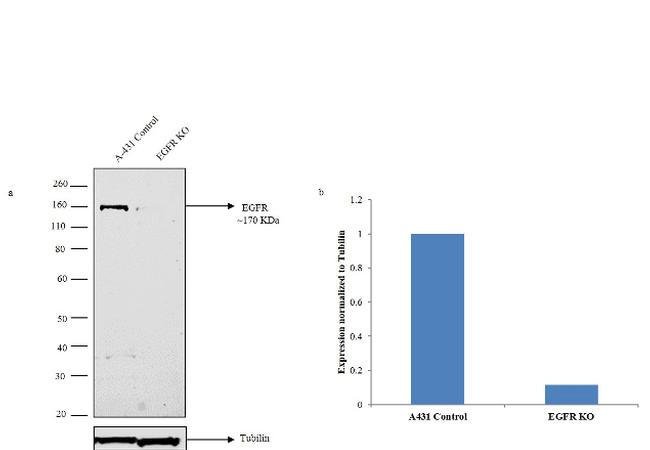
MA1-24226 detects both phosphorylated and un-phosphorylated EGFR in human samples. This antibody does not cross react with mouse or rat EGFR, or with ERbB2, ERbB3, or ERbB4. MA1-24226 has been successfully used in ELISA, Radioimmune assays, immunohistochemistry (paraffin & frozen) and immunoprecipitation procedures. The MA1-24226 immunogen is a synthetic peptide corresponding to residues D(985) V V D A D E Y L I P Q(996) of human EGFR. Store at 4°C short term. For extended storage aliquot and store at -20°C or below. Avoid freeze-thaw cycles.
EGFR (Epidermal growth factor receptor, HER1, ErbB1) is encoded by the EGFR gene located on chromosome 7 in humans. EGFR belongs to the HER/ERbB family of proteins that includes three other receptor tyrosine kinases, ERbB2, ERbB3, ERbB4. EGFR is a transmembrane receptor and binding of its cognate ligands such as EGF (Epidermal Growth Factor) and TGF alpha (Transforming Growth Factor alpha) to the extracellular domain leads to EGFR dimerization followed by autophosphorylation of the tyrosine residues in the cytoplasmic domain. Phosphorylation of EGFR at certain residues is also mediated by Src-non-receptor kinase. EGFR activation signals multiple downstream signaling cascades such as the Ras - ERK, PI3-K - Akt, Jak - STAT and PKC pathways that help in growth and proliferation of cells. Phosphorylation of EGFR at Y1086 specifically allows binding of the adaptor protein GRB2, leading to activation of the MAPK pathway. Upon receptor activation and signaling, EGFR is endocytosed and targeted for degradation or recycling. Mutations in the EGFR gene are associated with lung cancer and multiple alternatively spliced transcript variants encode different protein isoforms of EGFR have been found. Increased production or activation of EGFR has been associated with poor prognosis in a variety of tumors. Moreover, EGFR overexpression is observed in tumors of the head and neck, brain, bladder, stomach, breast, lung, endometrium, cervix, vulva, ovary, esophagus, stomach and in squamous cell carcinoma.
Specifications
| EGFR | |
| Monoclonal | |
| 1 mg/mL | |
| EGFR | |
| ERBB, ERBB1, HER1, PIG61, mENA, avian erythroblastic leukemia viral (v-erb-b) oncogene homolog, cell growth inhibiting protein 40, cell proliferation-inducing protein 61, proto-oncogene c-ErbB-1, receptor tyrosine-protein kinase erbB-1, epidermal growth f | |
| Mouse | |
| Protein A | |
| RUO | |
| 1956 | |
| Store at 4°C short term. For long term storage, store at -20°C, avoiding freeze/thaw cycles. | |
| Liquid |
| ELISA, Immunohistochemistry (Frozen), Immunohistochemistry (Paraffin), Immunoprecipitation, Radioimmune Assays (RIA), Western Blot | |
| F4 | |
| Unconjugated | |
| P00533 | |
| EGFR | |
| Synthetic peptide corresponding to residues D(985) V V D A D E Y L I P Q(996) of human EGFR. | |
| 100 μg | |
| Primary | |
| Human | |
| Antibody | |
| IgG1 |
Product Content Correction
Your input is important to us. Please complete this form to provide feedback related to the content on this product.
Product Title
Spot an opportunity for improvement?Share a Content Correction