missing translation for 'onlineSavingsMsg'
Learn More
Learn More

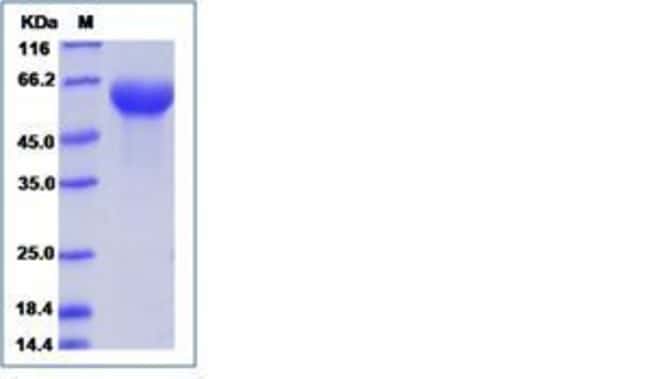
Invitrogen™ Human ROR1 Recombinant Protein, Biotin
Description
It is recommended that the protein be aliquoted for optimal storage. It is recommended that sterile water (400 μL) be added to the vial to prepare a stock solution of 0.25 mg/mL. Concentration is measured by UV.
Receptor-tyrosine-kinase-like orphan receptor 1 (ROR1) is a tumor-associated, surface protein predominantly expressed during embryogenesis, where it is involved in organ morphogenesis, nervous system development, and neural progenitor cell maintenance and survival. Virtually absent from normal pediatric and adult tissues, with the exception of low-level expression in a subset of immature b cell precursors known as hematogones and adipocytes, ROR1 is notably overexpressed, and considered a survival factor, in a number of B lymphoid and epithelial malignancies: including chronic lymphocytic leukemia (CLL), mantle cell lymphoma (MCL), acute lymphoblastic leukemia (ALL), marginal zone lymphoma, lung adenocarcinoma. First identified during PCR-based cloning of a human neuroblastoma cell line in search of tyrosine kinases similar to tropomyosin-receptor-kinase (Trk) neurotropic receptors, ROR1, along with the related receptor tyrosine kinase (RTK) ROR2, was catalogued as an 'orphan' receptor due to the fact its related ligand remained elusive. Wnt-5a has since been suggested as a candidate ligand for ROR1, and ROR1 has been implicated to function as a pseudokinase, promoting proliferation and resistance to apoptosis in cancer cells through interaction with Wnt-5a, and TCL1-co-activation of AKT. ROR1 is expressed as a glycoprotein containing extracellular immunoglobulin (Ig)-like, Frizzled, and Kringle domains, as well as an intracellular region containing a tyrosine kinase domain.

Specifications
Specifications
| Accession Number | Q01973 |
| Concentration | 0.25 mg/mL |
| For Use With (Application) | Control, Neutralization |
| Formulation | PBS with 5% mannitol, 5% trehalose, 0.01% Tween 80 and no preservative |
| Gene ID (Entrez) | 4919 |
| Molecular Weight (g/mol) | 42.8 kDa |
| Name | Human ROR1 |
| Purification Method | Purified |
| Quantity | 20 μg |
| Storage Requirements | -20°C, Avoid Freeze/Thaw Cycles |
| Show More |
Product Title
By clicking Submit, you acknowledge that you may be contacted by Fisher Scientific in regards to the feedback you have provided in this form. We will not share your information for any other purposes. All contact information provided shall also be maintained in accordance with our Privacy Policy.
Ser du en mulighed for forbedring?