missing translation for 'onlineSavingsMsg'
Learn More
Learn More
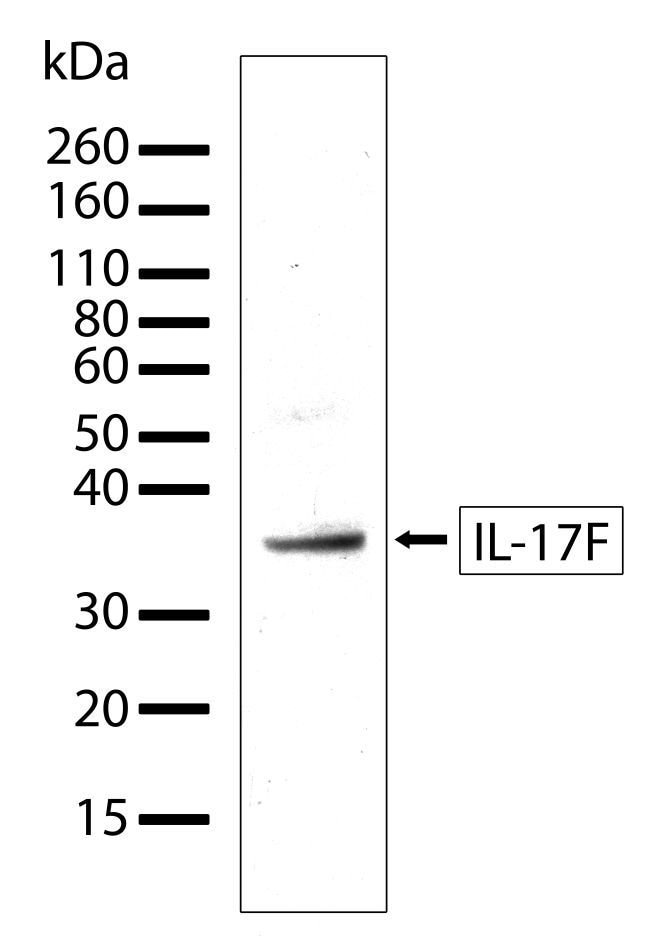
IL-17F Recombinant Polyclonal Antibody (5HCLC), Invitrogen™
Rabbit Recombinant Polyclonal Antibody
Brand: Invitrogen 710116
This item is not returnable.
View return policy
Description
Recombinant rabbit polyclonal antibodies are unique offerings from Thermo Fisher Scientific. They are comprised of a selection of multiple different recombinant monoclonal antibodies, providing the best of both worlds - the sensitivity of polyclonal antibodies with the specificity of monoclonal antibodies - all delivered with the consistency only found in a recombinant antibody. While functionally the same as a polyclonal antibody - recognizing multiple epitope sites on the target and producing higher detection sensitivity for low abundance targets - a recombinant rabbit polyclonal antibody has a known mixture of light and heavy chains. The exact population can be produced in every lot, circumventing the biological variability typically associated with polyclonal antibody production.
IL-17F (Interleukin 17F, CTLA-8)) is a cytokine belonging to the IL-17 family that is produced by inflammatory cells such as activated T cells, mast cells, and basophils. IL-17F is involved in allergic airway inflammation, and can induce several cytokines, chemokines, and adhesion molecules in bronchial epithelial cells, vein endothelial cells, fibroblasts, and eosinophils. IL-17F may be secreted as a homodimer, or a heterodimer with IL17A. It acts by binding to the type I receptor, IL-17R, aiding recruitment of monocytes and neutrophils at the site of inflammation by increasing chemokine production. IL-17F also stimulates induction of other pro-inflammatory cytokines TNF alpha, IL-1 beta, IL-6, and IL-8, and reports strongly suggest the involvement of IL-17 in several chronic inflammatory diseases such as rheumatoid arthritis, psoriasis and multiple sclerosis. TGF-beta (differentiation) and IL-23 (expansion) are required for induction and maintenance of Th17 (IL-17 producing) cells, which in turn induce the other pro-inflammatory cytokines. IL-17F is produced, and exists, as a homo-dimer, with homology to a herpes virus early protein, is one of the six members (IL-17A-F) of this cytokine family, and is well characterized and highly expressed by activated effector memory T cells. IL-17F has been found to inhibit the angiogenesis of endothelial cells and induce endothelial cells to produce IL2, TGFB1/TGFB, and monocyte chemoattractant protein-1.
Specifications
| IL-17F | |
| Recombinant Polyclonal | |
| 0.5 mg/mL | |
| PBS with 0.09% sodium azide | |
| Q96PD4 | |
| IL17F | |
| Recombinant protein corresponding to amino acids 31–163 of human IL-17F | |
| 100 μg | |
| Primary | |
| Human | |
| Antibody | |
| IgG |
| Western Blot | |
| 5HCLC | |
| Unconjugated | |
| IL17F | |
| C87042; CANDF6; cytokine ML-1; IL17F; IL-17F; IL-24; ILN; Interleukin; interleukin 17F; Interleukin17F; interleukin-17F; interleukin-24; ML1; ML-1; mutant IL-17F | |
| Rabbit | |
| Protein A | |
| RUO | |
| 112744 | |
| Store at 4°C short term. For long term storage, store at -20°C, avoiding freeze/thaw cycles. | |
| Liquid |
Product Content Correction
Your input is important to us. Please complete this form to provide feedback related to the content on this product.
Product Title
Spot an opportunity for improvement?Share a Content Correction