missing translation for 'onlineSavingsMsg'
Learn More
Learn More
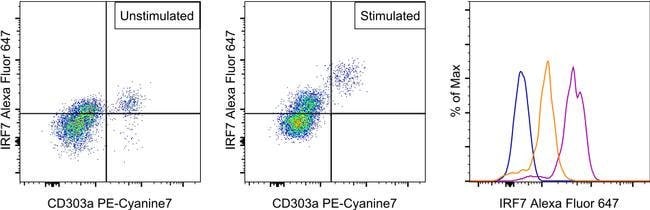
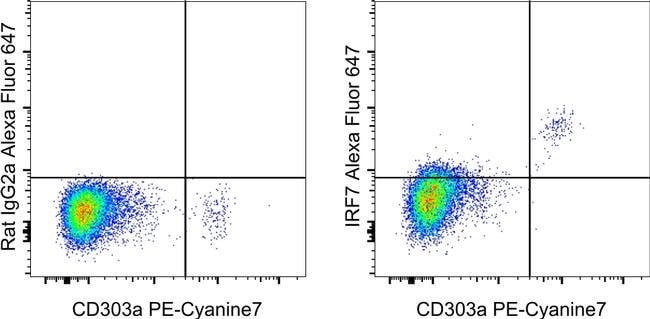
Invitrogen™ IRF7 Monoclonal Antibody (RDP4ND4), Alexa Fluor™ 647, eBioscience™
Rat Monoclonal Antibody
€ 459.38
Specifications
| Antigen | IRF7 |
|---|---|
| Clone | RDP4ND4 |
| Concentration | 5 μL/Test |
| Content And Storage | 4°C, store in dark, DO NOT FREEZE! |
| Applications | Flow Cytometry |
Description
Description: The monoclonal antibody RDP4ND4 recognizes human interferon regulatory factor 7 (IRF7), a 54 kDa member of the interferon regulatory transcription factor family. It is essential for the antiviral innate immune response and the activation of type I IFN genes. IRF7 is constitutively expressed in the cytoplasm of plasmacytoid dendritic cells, B cells and monocytes, but it is strongly induced in response to virus infection and interferon stimulation. IRF7 can activate IFN-beta and IFN-alpha genes via the virus-activated, MyD88-independent pathway, or the TLR-activated, MyD88-dependent pathway. Virus exposure induces IRF7, through toll-like receptors TLR7, TLR8, and TLR9, to promote IFN gene expression and disrupt infection. IRF7 exists in an inactive form until phosphorylated and its phosphorylation leads to dimerization and nuclear translocation of IRF7 where it aids in activating target genes. The IRF7 gene is upregulated by interferon stimulation through the Jak-STAT pathway in a positive feedback loop. Applications Reported: This RDP4ND4 antibody has been reported for use in flow cytometric analysis. Applications Tested: This RDP4ND4 antibody has been pre-diluted and tested by flow cytometric analysis of stimulated normal human peripheral blood cells using the Foxp3/Transcription Factor Staining Buffer Set (Product # 00-5523-00) and protocol. Please refer to BestProtocols®: Protocol B: One step protocol for (nuclear) intracellular proteins located under th...
Interferons (IFNs) are involved in a multitude of immune interactions during viral infections and play a major role in both the induction and regulation of innate and adaptive antiviral mechanisms. During infection, host-virus interactions signal downstream molecules such as transcription factors such as IFN regulatory factor-3 (IRF3) which can act to stimulate transcription of IFN-a/b genes. IRF7 has been shown to play a role in the transcriptional activation of virus-inducible cellular genes, including interferon beta chain genes. IRF7 play a major role in the innate immune pathway, interacting with the Toll-like receptor (TLR) adaptor proteins MyD88 and Tirp/TRAM and functioning as an intermediate TLR4 and TLR9 signaling. There are at least four differentially spliced isoforms of IRF7, although their function has not been clearly established.Specifications
| IRF7 | |
| 5 μL/Test | |
| Flow Cytometry | |
| Alexa Fluor 647 | |
| Rat | |
| RUO | |
| PBS with BSA and 0.09% sodium azide; pH 7.2 | |
| Q92985 | |
| 3665 | |
| Primary | |
| Affinity chromatography |
| RDP4ND4 | |
| 4°C, store in dark, DO NOT FREEZE! | |
| Monoclonal | |
| Liquid | |
| IgG2a κ | |
| Human | |
| IRF7 | |
| IMD39; Interferon regulatory factor 7; interferon regulatory factor-7H; Irf7; IRF-7; IRF7A; IRF7B; IRF7C; IRF7H; IRF-7H | |
| IRF7 | |
| Antibody |
Spot an opportunity for improvement?Share a Content Correction
Product Content Correction
Your input is important to us. Please complete this form to provide feedback related to the content on this product.
Product Title