missing translation for 'onlineSavingsMsg'
Learn More
Learn More
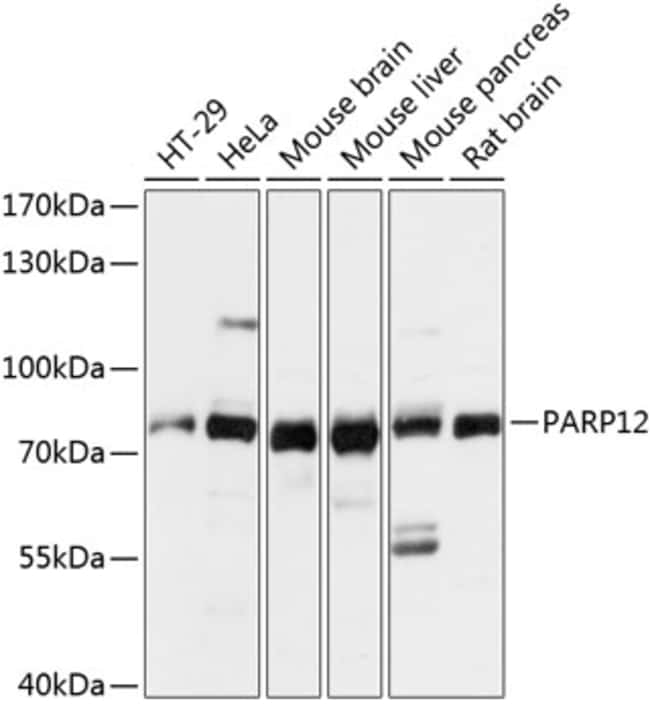
Invitrogen™ PARP12 Polyclonal Antibody

Description
Immunogen sequence: YVSPQDVTTM QTCNTKFPGP KSIPDYWDSS ALPDPGFQKI TLSSSSEEYQ KVWNLFNRTL PFYFVQKIER VQNLALWEVY QWQKGQMQKQ NGGKAVDERQ LFHGTSAIFV DAICQQNFDW RVCGVHGTSY GKGSYFARDA AYSHHYSKSD TQTHTMFLAR VLVGEFVRGN ASFVRPPAKE GWSNAFYDSC VNSVSDPSIF VIFEKHQVYP EYVIQYTTSS KPSVTPSILL ALGSLFSSRQ; Positive Samples: HT-29, HeLa, Mouse brain, Mouse liver, Mouse pancreas, Rat brain; Cellular Location: Nucleus.
Poly(ADP-ribosyl)ation is an immediate DNA-damage-dependent post-translational modification of histones and other nuclear proteins that contributes to the survival of injured proliferating cells. Poly(ADP-ribose) polymerases (PARPs) now constitute a large family of 18 proteins, encoded by different genes and displaying a conserved catalytic domain in which PARP-1 (113 kDa), the founding member, and PARP-2 (62 kDa) are so far the sole enzymes whose catalytic activity has been shown to be immediately stimulated by DNA strand breaks. A large repertoire of sequences encoding novel PARPs now extends considerably the field of poly(ADP-ribosyl)ation reactions to various aspects of the cell biology including cell proliferation and cell death. Some of these new members interact with each other, share common partners and common subcellular localizations suggesting possible fine tuning in the regulation of this post-translational modification of proteins.

Specifications
Specifications
| Antigen | PARP12 |
| Applications | ELISA, Western Blot |
| Classification | Polyclonal |
| Concentration | 1.84 mg/mL |
| Conjugate | Unconjugated |
| Formulation | PBS with 50% glycerol and 0.01% thimerosal; pH 7.3 |
| Gene | PARP12 |
| Gene Accession No. | Q8BZ20, Q9H0J9 |
| Gene Alias | 9930021O16; AA409132; AA536654; ADP-ribosyltransferase diphtheria toxin-like 12; ARTD12; MST109; MSTP109; PARP12; PARP-12; poly (ADP-ribose) polymerase family, member 12; poly [ADP-ribose] polymerase 12; poly ADP-ribose polymerase 12; poly(ADP-ribose) polymerase family member 12; Protein mono-ADP-ribosyltransferase PARP12; ZC3H1; Zc3hdc1; Zinc finger CCCH domain-containing protein 1; zinc finger CCCH type domain containing 1 |
| Gene Symbols | PARP12 |
| Show More |
Product Title
By clicking Submit, you acknowledge that you may be contacted by Fisher Scientific in regards to the feedback you have provided in this form. We will not share your information for any other purposes. All contact information provided shall also be maintained in accordance with our Privacy Policy.
Spot an opportunity for improvement?