missing translation for 'onlineSavingsMsg'
Learn More
Learn More
Invitrogen™ Phospho-beta Catenin/gamma Catenin (Tyr333, Tyr324) Polyclonal Antibody

Description
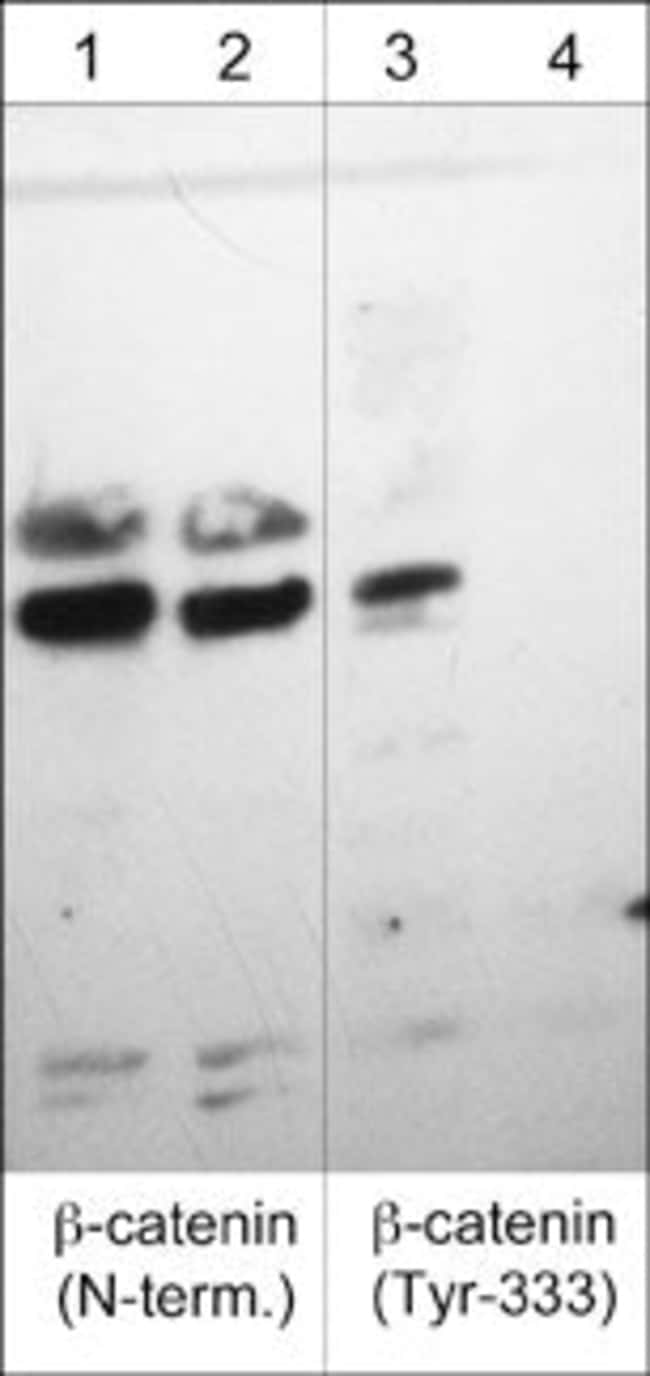
The antibody detects a 92kDa* protein corresponding to the molecular mass of beta-Catenin on SDS-PAGE immunoblots of human A431 cells treated with pervanadate, but not in control cells. In addition, the pervanadate induced reactivity is not observed after alkaline phosphatase treatment.
beta-Catenin is a 92 kDa protein that binds to the cytoplasmic tail of E-Cadherin. The cadherins, transmembrane adhesion molecules, are found with catenins at adherens junctions. Deletions in the cytoplasmic domain of E-Cadherin eliminate catenin binding and result in a loss of cell adhesion. Tyrosine phosphorylation of beta-Catenin can regulate its interaction with critical components of adherens junctions. Both Fer and Fyn kinases phosphorylate tyrosine 142 in vitro. Overexpression of these kinases in epithelial cells disrupts interactions between alpha- and beta-Catenins. The phosphorylation of tyrosine 142 may act as a switch from the transcriptional to the adhesive role of beta-Catenin. Src family kinases can also phosphorylate tyrosine 86 and 654 in beta-Catenin. The Tyr-654 phosphorylation regulates beta-Catenin binding to E-cadherin. Thus, site-specific tyrosine phosphorylation of beta-Catenin may regulate protein-protein interactions leading to changes in cell adhesion.

Specifications
Specifications
| Antigen | Phospho-beta Catenin/gamma Catenin (Tyr333, Tyr324) |
| Applications | Western Blot |
| Classification | Polyclonal |
| Concentration | 1 mg/mL |
| Conjugate | Unconjugated |
| Formulation | PBS with 1mg/mL BSA, 50% glycerol and 0.05% sodium azide |
| Gene | CTNNB1 |
| Gene Accession No. | P35222, Q02248, Q9WU82 |
| Gene Alias | Catenin beta1; CTNNB1 |
| Gene Symbols | CTNNB1 |
| Show More |
Product Title
By clicking Submit, you acknowledge that you may be contacted by Fisher Scientific in regards to the feedback you have provided in this form. We will not share your information for any other purposes. All contact information provided shall also be maintained in accordance with our Privacy Policy.
Spot an opportunity for improvement?