missing translation for 'onlineSavingsMsg'
Learn More
Learn More
Invitrogen™ phospho-Tyrosine Monoclonal Antibody (pY20), eFluor™ 660, eBioscience™

Mouse Monoclonal Antibody
Brand: Invitrogen™ 50-5001-42
This item is not returnable.
View return policy
Description
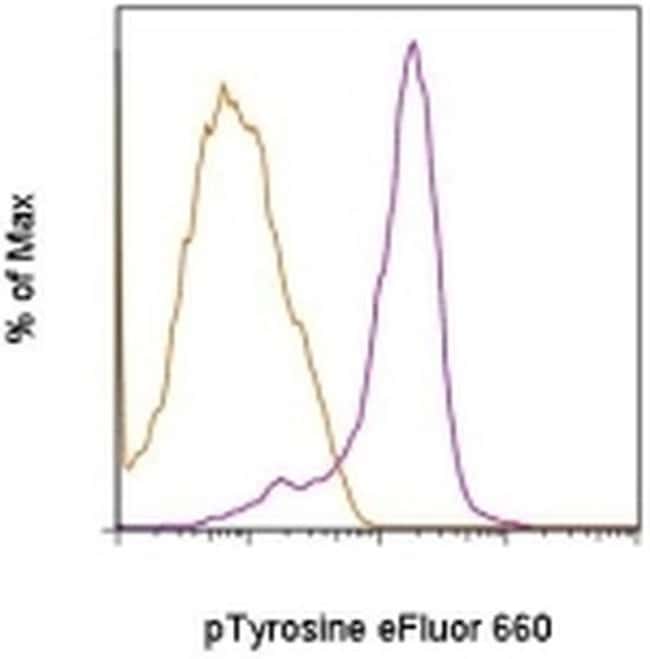
Description: The pY20 monoclonal antibody recognizes phosphorylated tyrosine residues (p-Tyr) on proteins. Numerous intracellular signaling cascades are propagated via phosphorylation of specific tyrosine on signaling proteins. The detection of p-Tyr residues is valuable for the characterization and purification of phosphorylated proteins and the biochemical pathways that they are involved in. Applications Reported:This pY20 antibody has been reported for use in intracellular staining followed by flow cytometric analysis. Applications Tested: This pY20 antibody has been pre-titrated and tested by intracellular staining followed by flow cytometric analysis of normal human peripheral blood cells. This can be used at 5 μL (0.06 μg) per test. A test is defined as the amount (μg) of antibody that will stain a cell sample in a final volume of 100 μL. Cell number should be determined empirically but can range from 10^5 to 10^8 cells/test. Staining Protocol: All protocols work well for this monoclonal antibody. Use of Protocol A: Two-step protocol: intracellular (cytoplasmic) proteins allows for the greatest flexibility for detection of surface and intracellular (cytoplasmic) proteins. Use of Protocol B: One-step protocol: intracellular (nuclear) proteins is recommended for staining of transcription factors in conjunction with surface and phosphorylated intracellular (cytoplasmic) protein(s). Protocol C: Two-step protocol: Fixation/Methanol allows for the greatest disc...
The role of tyrosine phosphorylation in transduction of the mitogenic signal from transmembrane receptors and in transformation by oncogene tyrosine kinases has been the subject of intense investigation for several years. While the phosphorylation of specific tyrosine residues has been shown to be a primary mechanism of signal transduction during normal mitogenesis, cell cycle progression and oncogenic transformation, its role in other areas such as differentiation and gap junction communication, is a matter of active and ongoing research. Antibodies that specifically recognize phosphorylated tyrosine residues have proved to be invaluable to the study of tyrosine -phosphorylated proteins and the biochemical pathways in which they function. The fluorescein (FITC) conjugate of clone PY20 anti-phosphotyrosine is especially useful for the detection of these P-Tyr proteins in immunohistochemical and immunocytochemical protocols in situations wherein the use of a secondary antibody would complicate detection of the protein(s) of interest.
Specifications
| phospho-Tyrosine | |
| Monoclonal | |
| 5 μL/Test | |
| PBS with BSA and 0.09% sodium azide; pH 7.2 | |
| Mouse | |
| 100 Tests | |
| Primary | |
| 4°C, store in dark, DO NOT FREEZE! | |
| Liquid | |
| Chemical |
| Flow Cytometry | |
| pY20 | |
| eFluor 660 | |
| Phosphotyrosine; pTyr; pY | |
| Affinity chromatography | |
| RUO | |
| Chemical | |
| Antibody | |
| IgG2b κ |
Product Content Correction
Your input is important to us. Please complete this form to provide feedback related to the content on this product.
Product Title
Spot an opportunity for improvement?Share a Content Correction