missing translation for 'onlineSavingsMsg'
Learn More
Learn More
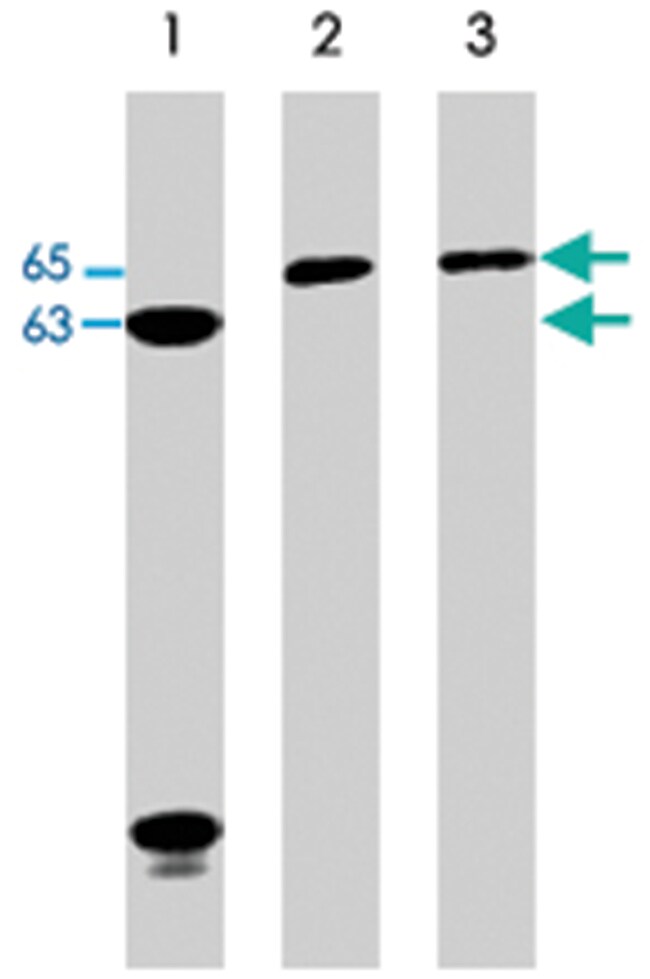
WASL Rabbit anti-Human, Mouse, Rat, Polyclonal Antibody, Abnova™
Rabbit polyclonal antibody raised against synthetic peptide of WASL.
Brand: Abnova PAB7875.100uL
This item is not returnable.
View return policy
Description
The Wiskott-Aldrich syndrome (WAS) family of proteins share similar domain structure, and are involved in transduction of signals from receptors on the cell surface to the actin cytoskeleton. The presence of a number of different motifs suggests that they are regulated by a number of different stimuli, and interact with multiple proteins. Recent studies have demonstrated that these proteins, directly or indirectly, associate with the small GTPase, Cdc42, known to regulate formation of actin filaments, and the cytoskeletal organizing complex, Arp2/3. The WASL gene product is a homolog of WAS protein, however, unlike the latter, it is ubiquitously expressed and shows highest expression in neural tissues. It has been shown to bind Cdc42 directly, and induce formation of long actin microspikes. [provided by RefSeq
Specifications
| WASL | |
| Polyclonal | |
| Rabbit polyclonal antibody raised against synthetic peptide of WASL. | |
| In PBS (50% glycerol, 1mg/mL BSA, 0.05% sodium azide) | |
| DKFZp779G0847/MGC48327/N-WASP/NWASP | |
| Rabbit | |
| 100 μL | |
| Primary | |
| This sequence is highly homologous with a similar region in human N-WASP. | |
| Store at -20°C. Aliquot to avoid repeated freezing and thawing. |
| ELISA, Western Blot | |
| Unconjugated | |
| ELISA (1:2000) Western Blot (1:500) The optimal working dilution should be determined by the end user. | |
| WASL | |
| WASL | |
| A synthetic peptide (conjugated with KLH) corresponding to C-terminus of human WASL. | |
| RUO | |
| 8976 | |
| Human, Mouse, Rat | |
| Liquid |
Product Content Correction
Your input is important to us. Please complete this form to provide feedback related to the content on this product.
Product Title
For Research Use Only
Spot an opportunity for improvement?Share a Content Correction