Learn More
Invitrogen™ RUNX1 Monoclonal Antibody (RXDMC), PE, eBioscience™

Description
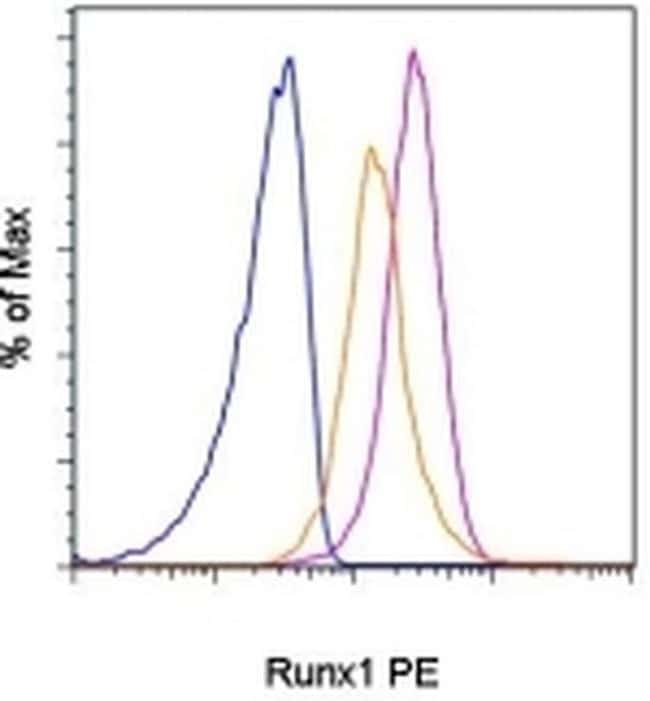
Description: This RXDMC monoclonal antibody reacts with human and mouse Runx1, which is also known as AML1. This 50-kDa transcription factor is expressed in hematopoietic cells such as myeloid, T, and B cells, but not erythroid cells. Furthermore, Runx1 can be detected in nearly all non-hematopoietic tissues except the brain and heart. Runx1 is involved in several stages of T cell development, including the CD4-CD8- double negative (DN) to CD4+CD8+ double positive (DP) transition and commitment to the CD4 lineage. In addition to its role in thymocyte development, Runx1 has also been implicated in Th2 differentiation and immune homeostasis via direct interaction with Foxp3 in CD4+CD25+ regulatory T cells. Runx1 also affects Th2 differentiation by negatively regulating Gata-3 expression. Finally, the AML1 gene, which encodes Runx1, is a frequent target of translocations in acute myeloid leukemia. In humans, alternative splicing results in the generation of eleven isoforms. In mice, five isoforms exist as a result of alternative splicing; isoform 4 (aka AML1-C) is the most highly expressed in hematopoietic cells. Sequence analysis indicates that the RXDMC antibody recognizes isoform 4 in mouse and all human isoforms except AML-1FA, AML-1FB, and AML-1FC. Applications Reported: This RXDMC antibody has been reported for use in intracellular staining followed by flow cytometric analysis. Applications Tested: This RXDMC antibody has been tested by intracellular staining and flow c...

Specifications
Specifications
| Antigen | RUNX1 |
| Applications | Flow Cytometry |
| Classification | Monoclonal |
| Clone | RXDMC |
| Concentration | 0.2 mg/mL |
| Conjugate | PE |
| Formulation | PBS with 0.09% sodium azide; pH 7.2 |
| Gene | RUNX1 |
| Gene Accession No. | Q01196, Q03347 |
| Gene Alias | acute myeloid leukemia 1 protein; Acute myeloid leukemia 2 protein; acute myeloid leukemia 3 protein; acute myeloid leukemia gene 2; AML1; AML-1; aml1 oncogene; AML1-EVI-1; AML1-EVI-1 fusion protein; AML2; AML3; AMLCR1; CBF2alpha; CBFA1; CBFA2; CBFA3; CBF-alpha 2; CBF-alpha-1; CBF-alpha-2; CBF-alpha-3; CCD; CCD1; CLCD; core binding factor alpha 2; core-binding factor runt domain alpha subunit 2 (acute myeloid leukemia 1 oncogene); Core-binding factor subunit alpha-1; Core-binding factor subunit alpha-2; core-binding factor subunit alpha-3; core-binding factor, runt domain, alpha subunit 1; core-binding factor, runt domain, alpha subunit 2; core-binding factor, runt domain, alpha subunit 3; EVI-1; Oncogene AML-1; oncogene AML-2; Oncogene AML-3; OSF2; OSF-2; osteoblast-specific transcription factor 2; OTTHUMP00000108697; OTTHUMP00000108700; OTTHUMP00000108702; PEA2 alpha C; PEA2aA; PEA2-alpha A; PEA2-alpha B; PEA2-alpha C; PEBP2 alpha C; PEBP2A; Pebp2a2; PEBP2A3; PEBP2aA; PEBP2aB; PEBP2aC; PEBP2alpha; PEBP2-alpha A; PEBP2-alpha B; PEBP2-alpha C; Pebpa2b; polyomavirus enhancer-binding protein 2 alpha A subunit; Polyomavirus enhancer-binding protein 2 alpha B subunit; polyomavirus enhancer-binding protein 2 alpha C subunit; RUN1; runt domain, alpha subunit 2; runt related transcription factor 1; runt related transcription factor 2; runt related transcription factor 3; runt-related transcription factor 1; Runt-related transcription factor 2; runt-related transcription factor 3; Runx1; RUNX1/ZNF687 fusion; RUNX2; RUNX3; SL3/AKV core-binding factor alpha A subunit; SL3/AKV core-binding factor alpha B subunit; SL3/AKV core-binding factor alpha C subunit; SL3-3 enhancer factor 1 alpha A subunit; SL3-3 enhancer factor 1 alpha B subunit; SL3-3 enhancer factor 1 alpha C subunit; transcription factor; transcription factor AML2 |
| Show More |
By clicking Submit, you acknowledge that you may be contacted by Fisher Scientific in regards to the feedback you have provided in this form. We will not share your information for any other purposes. All contact information provided shall also be maintained in accordance with our Privacy Policy.