missing translation for 'onlineSavingsMsg'
Learn More
Learn More
Invitrogen™ SARM Polyclonal Antibody

Description
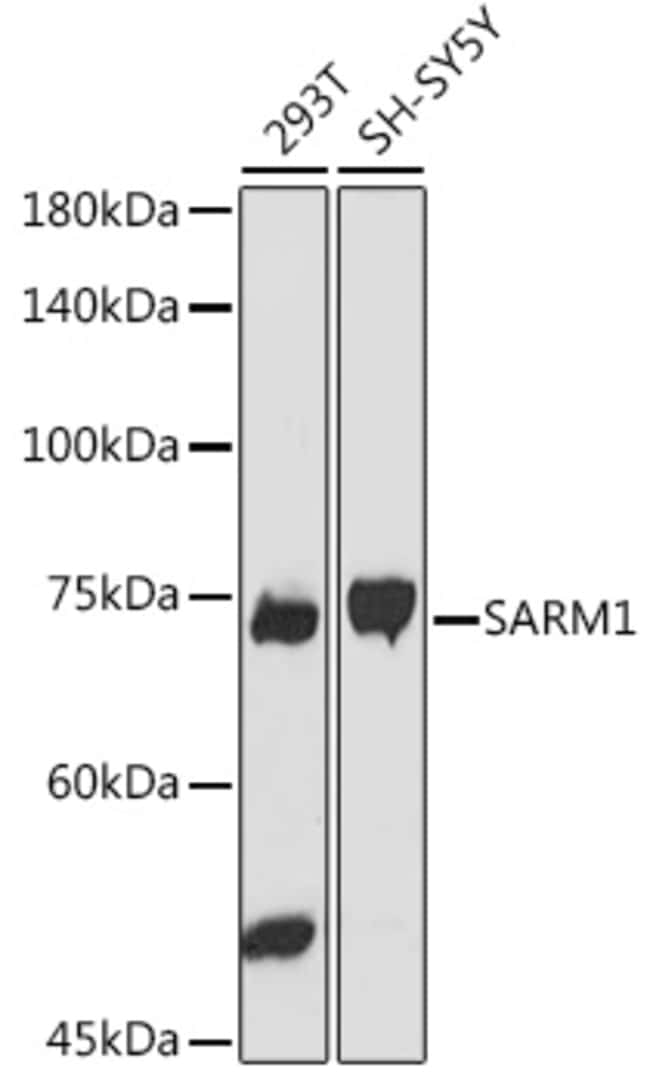
Positive test controls include: 293T, SH-SY5Y. Immunogen sequence: ALDKCMQDHD CKDWVHKEIV TALSCGKNIV PIIDGFEWPE PQVLPEDMQA VLTFNGIKWS HEYQEATIEK IIRFLQGRSS RDSSAGSDTS LEGAAPMGPT.
NAD(+) hydrolase, which plays a key role in axonal degeneration following injury by regulating NAD(+) metabolism (PubMed:25908823, PubMed:27671644, PubMed:28334607). Acts as a negative regulator of MYD88- and TRIF-dependent toll-like receptor signaling pathway by promoting Wallerian degeneration, an injury-induced form of programmed subcellular death which involves degeneration of an axon distal to the injury site (PubMed:15123841, PubMed:16964262, PubMed:20306472, PubMed:25908823). Wallerian degeneration is triggered by NAD(+) depletion: in response to injury, SARM1 is activated and catalyzes cleavage of NAD(+) into ADP-D-ribose (ADPR), cyclic ADPR (cADPR) and nicotinamide; NAD(+) cleavage promoting cytoskeletal degradation and axon destruction (PubMed:25908823, PubMed:28334607, PubMed:30333228, PubMed:31128467, PubMed:31439793, PubMed:31439792). Also able to hydrolyze NADP(+), but not other NAD(+)-related molecules (PubMed:29395922). Can activate neuronal cell death in response to stress (PubMed:20306472). Regulates dendritic arborization through the MAPK4-JNK pathway. Involved in innate immune response: inhibits both TICAM1/TRIF- and MYD88-dependent activation of JUN/AP-1, TRIF-dependent activation of NF-kappa-B and IRF3, and the phosphorylation of MAPK14/p38 (PubMed:16964262). [UniProt].

Specifications
Specifications
| Antigen | SARM |
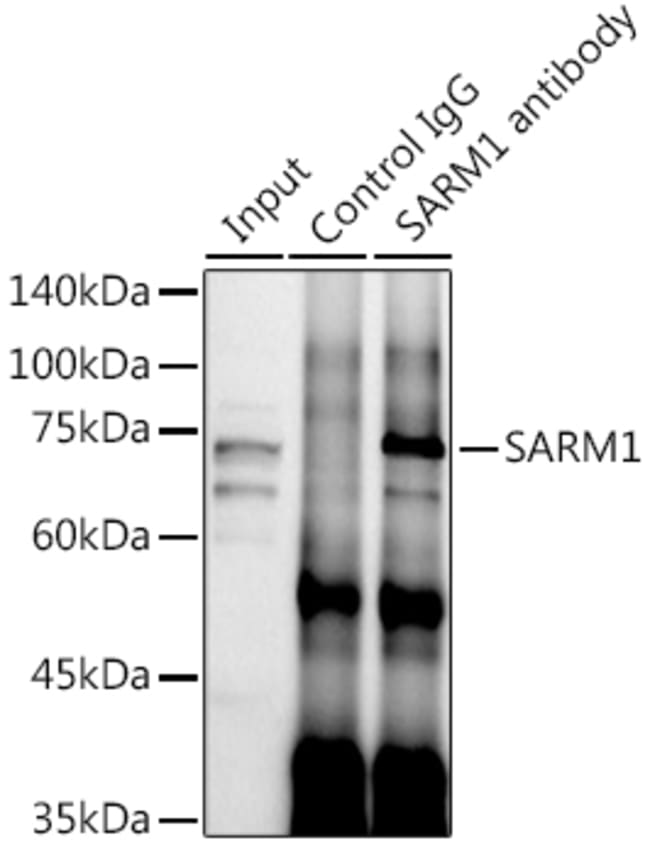
| Applications | ELISA, Immunoprecipitation, Western Blot |
| Classification | Polyclonal |
| Concentration | 2.09 mg/mL |
| Conjugate | Unconjugated |
| Formulation | PBS with 50% glycerol and 0.05% ProClin 300; pH 7.3 |
| Gene | SARM1 |
| Gene Accession No. | Q6SZW1 |
| Gene Alias | A830091I15Rik; C78606; FLJ36296; KIAA0524; MyD885; MyD88-5; SAM domain-containing protein 2; SAMD2; SARM; SARM1; Sterile alpha and Armadillo repeat protein; sterile alpha and HEAT/Armadillo motif containing 1; sterile alpha and HEAT/Armadillo motif protein, ortholog of Drosophila; sterile alpha and TIR motif containing 1; sterile alpha and TIR motif-containing protein 1; Sterile alpha motif domain-containing protein 2; tir-1 homolog |
| Gene Symbols | SARM1 |
| Show More |
Product Title
By clicking Submit, you acknowledge that you may be contacted by Fisher Scientific in regards to the feedback you have provided in this form. We will not share your information for any other purposes. All contact information provided shall also be maintained in accordance with our Privacy Policy.
Spot an opportunity for improvement?